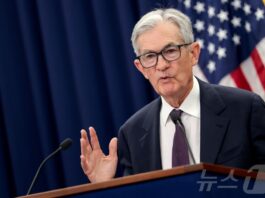
The Federal Reserve’s decision to raise its benchmark interest rate to 4% and signal potential further tightening this year has increased the likelihood of additional rate hikes by the Bank of Korea (BOK). With the interest rate gap between the U.S. and South Korea widening to 1 percentage point and high oil prices persisting, concerns about a weakening KRW and rising inflation pressures have intensified.
The BOK, which had planned to pause in October to assess the effects of consecutive rate hikes in July and August, now faces a complex situation. While current exchange rates and inflation conditions push for an additional increase, the already elevated market interest rates and the burden on households and businesses call for a more measured approach. The key question is whether the BOK will maintain its plan to hold rates in October and hike in November, or if it will move the timing of the increase forward.
On Wednesday, the Fed raised its policy rate by 0.25 percentage points to a range of 3.75% to 4.00%. This marks the resumption of tightening after more than three years, widening the gap between the upper end of U.S. interest rates and South Korea’s benchmark rate (3.00%) back to 1 percentage point.
As this gap expands, the BOK faces increased pressure to consider exchange rates and financial conditions in its upcoming rate decision on October 22.
Analysts suggest that if the KRW’s strength, which has helped mitigate the impact of rising oil prices, falters, the timeline for reaching a benchmark rate of 3.25% could be accelerated.
The Fed’s hawkish stance became evident during this meeting. The dot plot projects a median policy rate of 4.1% by the end of both this year and next, indicating expectations for one more increase this year and no rate cuts in 2026.
This contrasts with the June dot plot, which had anticipated one increase this year followed by one cut next year.
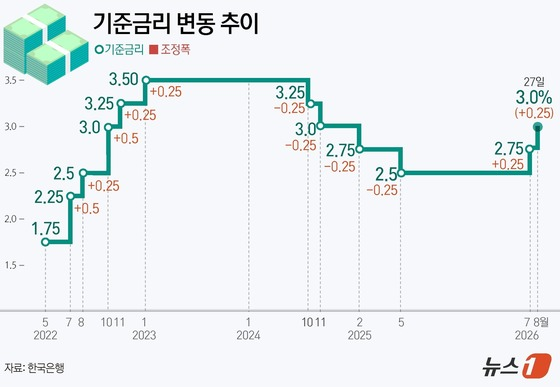
The BOK raised its benchmark rate by 0.5 percentage points in both July and August, signaling a gradual path of future increases. Last month’s monetary policy committee meeting forecast a median rate of 3.25% in six months, 0.25 percentage points higher than the current level.
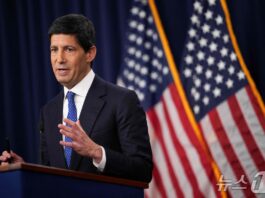
BOK Governor Shin Hyun-song explained that gradual increases were expected to allow time to evaluate the effects of the two consecutive hikes. This left the door open for a pause in October while keeping the option for further increases on the table.
However, as the Fed signals stronger tightening, the BOK may have less room to pause if the KRW weakens further and domestic inflation pressures rise. The market’s interest rate expectations, exchange rate responses, and overall financial conditions will be crucial factors in the next rate decision.
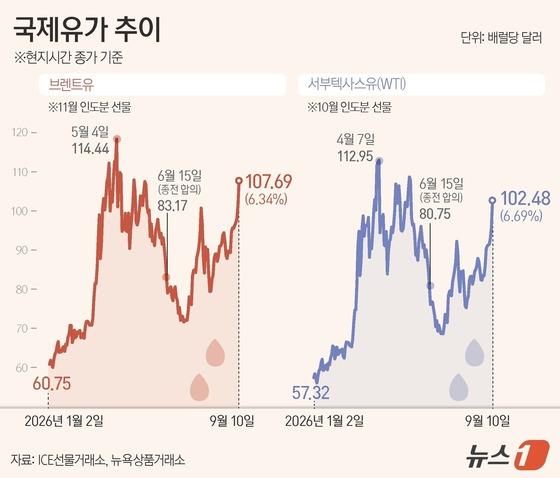
Last month, stable exchange rates countered rising oil prices, leading to a decline in import prices for three consecutive months. While Dubai crude prices rose 15.6%, from 76.75 USD to 88.75 USD per barrel, the USD-KRW exchange rate fell 6.1% from 1,497.43 KRW (about 1.12 USD) to 1,406.30 KRW (about 1.05 USD), resulting in a 2.4% drop in import prices in KRW terms.
However, renewed conflicts in the Middle East have driven oil prices up rapidly this month. On Monday, Dubai crude hit 126.70 USD per barrel, a 42.8% increase over the August average.
The strengthening USD due to the Fed’s hawkish stance further raises concerns about import prices. On Wednesday, the USD-KRW exchange rate closed at 1,368.6 KRW (about 1.03 USD), up 32.5 KRW (about 0.02 USD) from 1,336.1 KRW (about 1.00 USD) on September 9.
Rising import prices are expected to put upward pressure on domestic consumer prices. The BOK’s price statistics team predicts continued double-digit increases in import prices compared to last year.
However, the Fed’s rate increases don’t automatically trigger hikes by the BOK. The semiconductor boom and large current account surplus could limit the KRW’s weakness. If exchange rates stabilize despite high oil prices, the BOK will have more time to assess the effects of previous rate hikes.
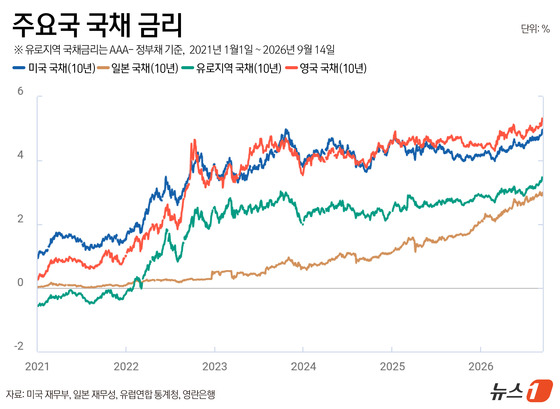
Recent market interest rate increases also push the BOK to consider a slower pace. U.S. 10-year Treasury yields hit 5.041% on Tuesday, the highest since July 2007.
This raises concerns about rising funding costs across various bonds, potentially increasing pressure on domestic borrowing rates. Even if the BOK holds rates steady next month, rising market rates could impact loan costs, constraining household consumption and corporate investment.
The potential for rising rates to affect vulnerable sectors of the economy cannot be ignored, potentially strengthening the case for an October pause.
Last month’s monetary policy committee minutes showed that one member advocated maintaining the current rate, citing concerns about economic polarization and vulnerable sectors.
The Fed’s hawkish stance creates a dilemma: addressing inflation while increasing economic costs associated with rate hikes. The BOK will likely consider inflation, growth, housing market trends, household loans, and the impact of Fed tightening on exchange rates and financial conditions in its decision-making process.