

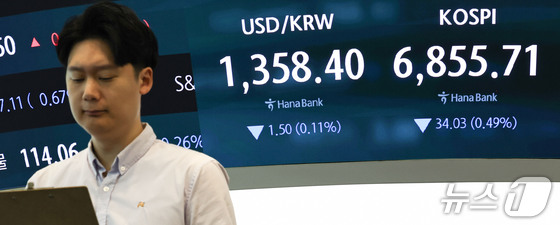
Samsung Electronics and SK Hynix have rebounded from early losses, now trading slightly higher despite the surge in U.S. Treasury yields and weakness in semiconductor stocks. This recovery is attributed to bargain hunting following the previous day’s sell-off, which had already priced in concerns about potential artificial intelligence (AI) development slowdowns.
As of 9:16 a.m. (KST) on Tuesday, Samsung Electronics was trading at 272,000 KRW (about 200 USD), up 2,000 KRW (about 1.47 USD) (0.74%) from the previous close. SK Hynix saw a 5,000 KRW (3.68 USD) (0.28%) increase, reaching 1,773,000 KRW (about 1,306 USD).
Samsung Electronics opened 1.48% lower at 266,000 KRW (about 196 USD) and initially dipped to 263,000 KRW (about 194 USD) before recovering its losses. SK Hynix also started down 0.74% at 1,755,000 KRW (about 1,293 USD) but has since climbed back to break-even levels.
Notably, Samsung Electronics is showing strength despite today being the ex-dividend date for its third-quarter payout. While stock prices typically fall by the dividend amount on such days, Samsung’s shares are actually trading above yesterday’s closing price.
Overnight, U.S. markets saw continued weakness in semiconductor stocks, particularly in the memory chip sector. The Philadelphia Semiconductor Index fell 1.61% on Monday, with SK Hynix’s American Depositary Receipts (ADRs) plummeting 5.03%. Micron, set to report quarterly earnings on September 30, also dropped 2.61%.
The semiconductor sell-off was exacerbated by surging U.S. Treasury yields. Amid uncertainties surrounding U.S.-Iran negotiations and inflation fears fueled by high oil prices, the 10-year Treasury yield spiked to 5.27% during trading. These elevated long-term rates are putting pressure on the lofty valuations of AI and chip stocks, which have seen significant gains recently.
Investor sentiment was further dampened by news that OpenAI has temporarily paused the training of its most advanced AI model. This raised concerns that a slowdown in AI development could potentially impact demand for graphics processing units (GPUs) and high-bandwidth memory (HBM) used in large-scale AI training, contributing to the broader weakness in chip stocks.
Han Ji-young, an analyst at Kiwoom Securities, commented that while OpenAI’s decision to pause AI training has indeed affected market sentiment, it’s likely a temporary measure. It’s premature to interpret this as the beginning of a significant slowdown in AI development.
Han added that the market is expected to open lower today due to the spike in U.S. 10-year yields, weakness in U.S. chip stocks following the OpenAI news, and Samsung’s ex-dividend date. However, much of the negative impact from OpenAI has already been priced in, and it anticipates some recovery as bargain hunters enter the market.