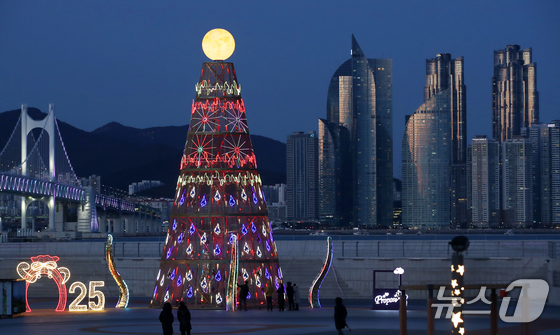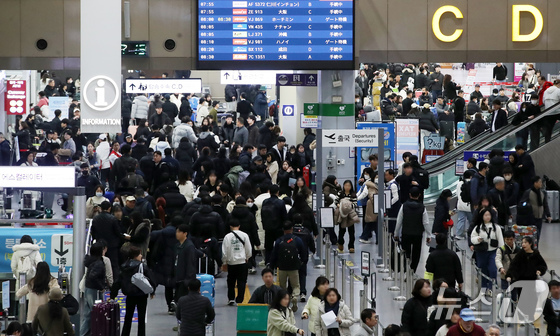
The Busan Syndrome has led to a surge in passenger traffic at Gimhae Airport, with numbers up over 10% this year. If this trend continues, the airport is set to welcome a record-breaking 19 million passengers in 2026. This boom stands in stark contrast to most regional airports, which are grappling with dwindling passenger numbers.
The Busan Syndrome is the latest travel buzz, describing the intense longing visitors feel for Busan’s unique blend of urban chic and seaside charm after returning home. Young travelers from across Asia, particularly Taiwan and Japan, have taken to social media to share their Busan withdrawal symptoms, turning it into a viral phenomenon. In Japan, they’ve even coined the term “Busan-ari” to describe this post-trip nostalgia.
Sensing an opportunity, national airlines have ramped up their international flights from Gimhae to capitalize on the growing Busan wanderlust.
Domestic Flights Down 3.6% vs. International Flights Up 22.7%… Tourists from Japan and Taiwan Flock to Busan
According to the Korea Airports Corporation, Gimhae Airport saw a total of 13,812,828 passengers from January to September this year, marking a 12.6% increase from the 12,272,326 during the same period last year. If this upward trend continues, annual passenger numbers could hit a staggering 19 million, shattering the previous record of 17,064,613 set in 2018.
The driving force behind Gimhae Airport’s passenger boom this year has been international flights. From January to September, international passenger numbers soared to 9,243,158, a 22.7% jump from 7,531,631 during the same period last year. In contrast, domestic passenger numbers saw a slight dip, falling from 4,740,695 to 4,569,670, a 3.6% decrease. As a result, international flights now account for a whopping 66.9% of all passenger traffic at Gimhae Airport.
The surge in foreign tourists has been pinpointed as the key factor fueling the growth of international flights at Gimhae Airport. Data from the Ministry of Justice, submitted to lawmaker Kwak Gyu-taek, shows that the number of foreign passengers using Gimhae’s international flights is projected to skyrocket from about 1.54 million in 2023 to 2.43 million in 2024, and around 3.25 million last year. The first half of this year alone saw about 2.08 million foreign passengers, a staggering 44.6% increase from the 1.44 million during the same period last year.
Japan and Taiwan routes have seen particularly impressive growth. In the first half of this year, passenger numbers on Gimhae-Japan routes hit about 2,594,000, up 38.5% from last year, while Taiwan routes saw a 51.8% increase, reaching approximately 946,000 passengers. These two routes alone accounted for about 1.04 million of the total 1.14 million increase in international passengers, an astounding 91% of the growth.
Domestic Airlines Accelerate Route Expansion for Winter Season, Pushing Gimhae Airport to Capacity
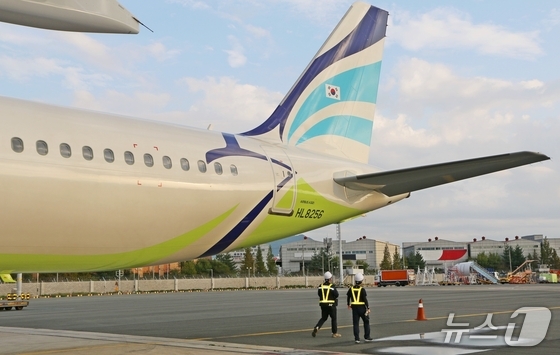
National airlines are doubling down on their expansion of international routes from Gimhae, with a focus on Japan and Greater China. Jin Air has launched exciting new routes to Taichung, Miyakojima, and Phu Quoc. Air Busan is now flying to Shizuoka and Takamatsu, while Trinity Air has started Tokyo (Narita) operations. Eastar Jet introduced an Almaty route, and Jeju Air recently opened up Guilin to eager travelers.
Airlines are also beefing up their existing routes. Jeju Air increased its Osaka flights from 14 to 17 per week, while Air Busan expanded its Nagasaki charter flights from 3 to 5 weekly. Eastar Jet added a whopping 58 flights to Fukuoka and 56 to Taipei between August and October.
The upcoming winter flight schedule, kicking off on October 25, promises even more options for travelers. Jeju Air is set to operate daily flights to Shanghai, up from 4 weekly, right from the start of the winter season. Come December 17, they’ll launch a new Busan-Manila route with 5 weekly flights, bringing their total international routes from Busan to an impressive 15.
Air Busan is jumping on the trend with a new Chiang Mai route launching November 11, initially offering 4 weekly flights. During the peak winter season from December 22 to February 28, they’ll ramp up to 6 flights a week. Not to be outdone, Eastar Jet is introducing a thrice-weekly Xiamen route on October 29 and a four-times-weekly Hangzhou route on December 3.
However, this passenger boom comes with a catch – increasing congestion at Gimhae Airport. The international terminal’s annual capacity of 8.3 million passengers was already exceeded by September, with 9.24 million travelers passing through – an 11.4% overflow in just nine months. This capacity was only recently increased from 6.3 million after a five-year expansion project completed in April 2024.