

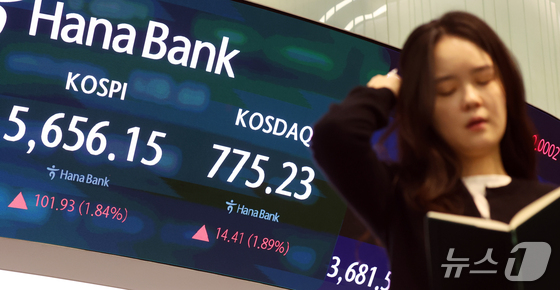
South Korean pharmaceutical and biotech stocks rallied early on Friday. This positive trend is attributed to increased interest in healthcare stocks, as investors showed caution towards artificial intelligence (AI)-related stocks in U.S. markets overnight. The shift boosted investor sentiment in the domestic market.
At 10:07 a.m. (KST), Celltrion was trading at 192,600 KRW (about 145 USD), up 10,500 KRW (7.89 USD) (5.77%) from the previous session. Samsung Biologics saw a rise of 48,000 KRW (36 USD) (3.85%), reaching 1,295,000 KRW (about 973 USD).
Other pharmaceutical companies also posted gains, with Yuhan Corporation up 4.84%, Hanmi Pharmaceutical rising 3.11%, and Kukje Pharma climbing 5.62%. Biotech firms like OliX Pharmaceuticals and LigaChem Bio (141080) surged 9.85% and 8.44%, respectively.
On Wall Street, healthcare stocks led the rally. The S&P 500 healthcare sector jumped 1.84% on Thursday, outperforming all other sectors. Notable gainers included Eli Lilly (3.55%), Gilead Sciences (2.49%), Biogen (1.08%), and UnitedHealth (2.8%).
Investors flocked to less cyclical sectors like healthcare and consumer goods, driven by concerns over substantial borrowing and investment costs in AI companies. This trend contrasted sharply with Nvidia’s 1.8% decline and the Philadelphia Semiconductor Index’s seventh consecutive day of losses.
Positive clinical news also bolstered the sector. Eli Lilly reported promising results for its inflammatory bowel disease treatment, Ombo. In a new clinical analysis, 27.7% of ulcerative colitis patients and 20.4% of Crohn’s disease patients achieved strict composite treatment goals.
The U.S. producer price index (PPI) for September rose 6.3% year-over-year, surpassing the expected 5.5% increase. This suggests that the strength in U.S. healthcare stocks is driven more by a rotation into defensive stocks rather than expectations of interest rate cuts.