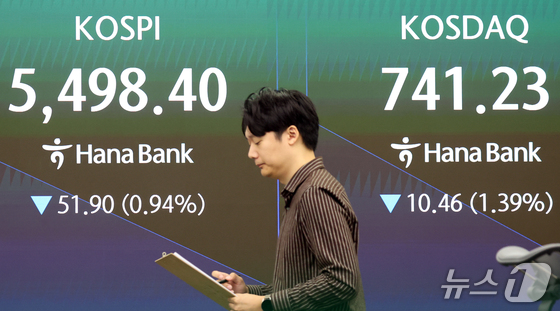
Last Friday, memory chip stocks rebounded on Wall Street, leading to mixed performance for Samsung Electronics and SK Hynix in early trading on Monday. Samsung Electronics hovered around its previous close, while SK Hynix surged over 2%.
At 9:10 a.m. (KST), Samsung Electronics was trading at 215,000 KRW (about 162 USD), down 500 KRW (about 0.38 USD) (0.23%) from the previous session. SK Hynix climbed 31,000 KRW (about 23.41 USD) (2.43%) to 1,308,000 KRW (about 987.63 USD).
Samsung Electronics initially dipped to 211,500 KRW (about 159.7 USD) before recouping losses, trading near its opening price. In contrast, SK Hynix bounced back from an early low of 1,272,000 KRW (about 960 USD), reaching as high as 1,315,000 KRW (about 993 USD) during the session.
On October 23, U.S. markets saw bargain hunters swoop in on recently battered chip stocks. The Philadelphia Semiconductor Index edged up 0.44%, with Micron Technology jumping 2.46%. Other gainers included AMD (1.74%), Intel Corporation (1.72%), and Marvell Technology (2.26%).
SK Hynix’s American Depositary Receipts (ADRs) stood out with a 4.05% increase. Analysts attribute this rise to eased concerns about shareholder dilution following SK Hynix’s decision to shelve the inital public offering (IPO) plans for its U.S. NAND flash unit, Solidigm.
Investors are also eyeing potential windfall returns from SK Hynix. Reports suggest the company is mulling a special dividend of around 16 trillion KRW (about 12.1 billion USD) from the estimated 20 trillion KRW (about 15.1 billion USD) profit on its stake sale in Japanese NAND maker Kioxia. More details are expected during SK Hynix’s Q3 earnings call on October 28.
Wall Street is keenly awaiting this week’s Q3 reports from both Samsung Electronics and SK Hynix. With recent jitters over AI investment returns, analysts are focusing on the chip sector’s growth sustainability and possible shareholder reward policies.
Kiwoom Securities analyst Han Ji-young noted that investors are more concerned about chip profits beyond 2027-2028 than current earnings. This quarter’s conference calls will be crucial for insights on high-bandwidth memory and dynamic random access memory (DRAM) demand, pricing trends, and supply-demand dynamics as production ramps up.
Han added that this earnings season could mark a turning point for stock volatility, depending on profit reliability and any new shareholder return initiatives announced.