As South Korea faces declining birth rates alongside rising numbers of older mothers and multiple pregnancies, the proportion of preterm births continues to increase. The number of high-risk pediatric patients requiring surgery and anesthesia for conditions such as congenital heart disease, gastrointestinal disorders and neurosurgical diseases is also growing, increasing the need for precise physiologic monitoring to ensure safe anesthesia and surgical care.
Against this backdrop, a team of South Korean researchers has published an artificial intelligence (AI) model that uses physiologic data to provide noninvasive surgical monitoring for pediatric patients, with the goal of reducing unnecessary invasive procedures and improving postoperative outcomes.
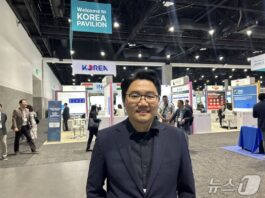
The Catholic University of Korea’s Seoul St. Mary’s Hospital announced on July 21 that a research team led by Professor Kim Hyun-ho of the Department of Pediatrics at St. Nicholas Children’s Hospital developed an AI model capable of estimating arterial partial pressure of carbon dioxide (PaCO₂) during surgery using physiologic monitoring data.
Arterial partial pressure of carbon dioxide is a key indicator used to evaluate mechanical ventilation settings and respiratory status during surgery. It is essential for detecting respiratory abnormalities and acid-base imbalances that may occur under anesthesia in real time.
The most accurate measurement method requires inserting an arterial catheter into the radial or femoral artery and analyzing a blood sample with a blood gas analyzer. However, because children have much smaller blood vessels, arterial catheterization carries a greater risk of complications, including vascular injury and impaired blood flow, than it does in adults.
Repeated blood sampling can also contribute to anemia in pediatric patients who have already experienced blood loss during surgery, creating challenges for clinicians trying to balance patient safety during surgery with improved postoperative outcomes.
To address these limitations, clinicians have also used end-tidal carbon dioxide (EtCO₂), which can be measured noninvasively. However, discrepancies between EtCO₂ and actual arterial carbon dioxide levels can occur because of factors such as ventilation-perfusion mismatch.
To overcome these limitations, the research team developed an AI model that combines end-tidal carbon dioxide measurements with clinical information to estimate arterial carbon dioxide levels more accurately in pediatric patients.
The researchers retrospectively analyzed 8,853 paired end-tidal carbon dioxide and arterial carbon dioxide measurements collected from 3,586 pediatric patients included in VitalDB, a publicly available operating room physiologic database developed by researchers in the Department of Anesthesiology and Pain Medicine at Seoul National University Hospital.
The team then applied SHAP (Shapley Additive Explanations) analysis to quantify the contribution and direction of each variable used in the model. Derived from game theory, SHAP is commonly used to explain machine learning “black box” models by calculating how much and in what direction each input variable influences a prediction for an individual patient.
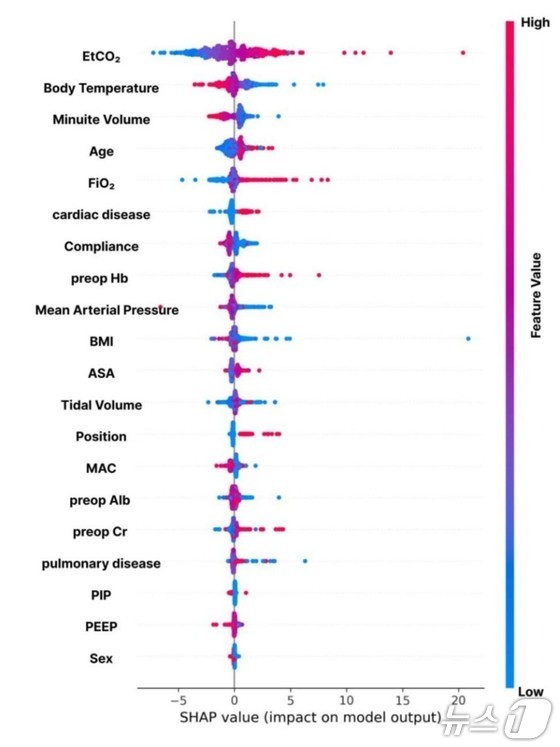
Using this approach, the researchers identified 10 key variables: end-tidal carbon dioxide, body temperature, minute ventilation, age, fraction of inspired oxygen (FiO₂), presence of heart disease, lung compliance, preoperative hemoglobin, body mass index and mean arterial pressure.
After training the machine learning algorithm with these variables, the researchers confirmed that the model could estimate arterial carbon dioxide levels during surgery with high accuracy.
The study is the first to estimate arterial carbon dioxide levels in pediatric patients using a broad range of physiologic data collected during surgery. Compared with the conventional method using end-tidal carbon dioxide alone, which had a mean error of 3.56 mmHg, the AI model reduced the mean absolute error (MAE) by about 23% to 2.73 mmHg, demonstrating a meaningful improvement in performance.
The model also demonstrated reproducibility in external validation using recent patient data from two additional university hospitals. It recorded an MAE of 3.65 mmHg in 92 measurements from 50 pediatric patients at Chungnam National University Hospital. In a temporal validation cohort of 2,138 measurements from 499 patients collected at Seoul National University Hospital between January 2024 and June 2025, the model achieved an MAE of 3.67 mmHg. Consistent performance across independent institutions and time periods suggests the model has potential for future clinical use.
“The model developed in this study cannot completely replace arterial blood gas testing, but it could serve as a useful adjunct in situations where arterial catheterization is difficult or frequent blood gas testing is impractical,” Professor Kim said.
He added, “It may be particularly useful in procedures such as pediatric neurosurgery, where precise carbon dioxide management is essential. However, additional validation through prospective clinical trials will be necessary before it can be implemented in routine clinical practice.”
The study was conducted with participation from Park Ju-hyun, a resident in the Department of Anesthesiology and Pain Medicine at Asan Medical Center, and Cho Chae-eun, a medical student at Korea University College of Medicine. The findings were recently published in the international journal Anesthesiology.
Seoul St. Mary’s Hospital opened St. Nicholas Children’s Hospital in December to provide specialized, comprehensive care for critically ill and pediatric patients with rare, intractable diseases. The hospital operates an independent pediatric intensive care unit and one of the nation’s largest neonatal intensive care units, with pediatric specialists available on-site 24 hours a day, 365 days a year.