

Hyundai Engineering & Construction has secured a position to participate in the U.S. fourth-generation small modular reactor (SMR) project, from initial design review through to future engineering, procurement, and construction (EPC) phases.
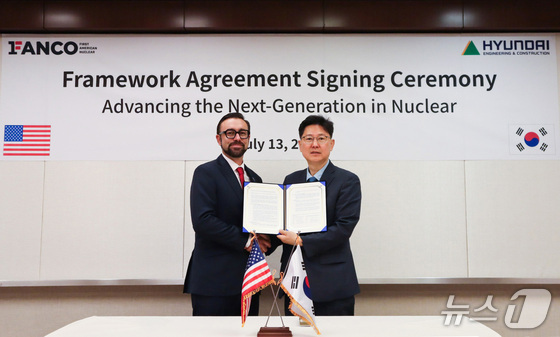
Hyundai announced on Tuesday that it had signed a memorandum of understanding with U.S. SMR developer First American Nuclear Corporation (FANCO) in New York on Monday for collaboration on the EAGL-1 Project.
EAGL-1 is an SMR based on a liquid metal-cooled fast reactor (LMFR) technology, utilizing a coolant composed of liquid lead (Pb) and bismuth (Bi) alloy. It represents one of the fourth-generation nuclear systems.
Specifically, the project envisions constructing a cluster of six reactors based on modular design, capable of supplying electricity to approximately 1.2 million households.
Under this agreement, Hyundai and FANCO will collaborate on the design of the balance of plant (BOP), support for bridge power solutions, constructability reviews, and modularization strategies.
Hyundai plans to explore avenues for participating as an EPC partner in the EAGL-1 project.
A spokesperson for Hyundai stated that this agreement provides them with an opportunity to be involved from the initial design review stage through to the EPC execution of the next-generation SMR project in the U.S. It also expands the network for reactor collaboration within the country.