
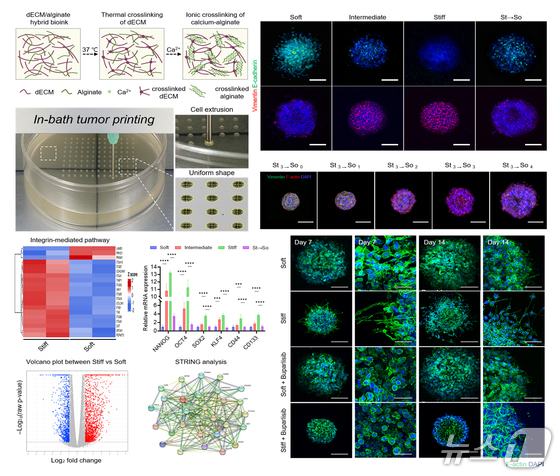
A groundbreaking study has uncovered a concerning link between the stiffening of the environment surrounding cancer cells and increased cancer aggressiveness, along with reduced treatment efficacy.
On Tuesday, Pusan National University announced that a collaborative research effort, led by Professor Kim Byung-soo from the Department of Biomedical Convergence Engineering and Professor Jo Won-woo from Yonsei University’s Department of Medical Engineering, has identified the mechanical stiffness of the tumor microenvironment as a key factor in promoting cancer cell malignancy and treatment resistance.
The university emphasized the significance of this research, noting its systematic approach in elucidating how the physical characteristics of the tumor microenvironment impact cancer progression and treatment failure.
Tumor tissues are known to exhibit greater mechanical stiffness compared to normal tissues, a characteristic closely associated with cancer progression, metastasis, and drug resistance.
Until now, the precise mechanisms by which mechanical stress in the tumor microenvironment activates intracellular signaling and induces malignant phenotypes have remained elusive, largely due to limitations in existing experimental models.
This groundbreaking study experimentally confirmed that the physical factor of stiffness in the tumor microenvironment plays a crucial role in driving cancer malignancy and treatment failure. Furthermore, the research team introduced a standardised three-dimensional (3D) cancer model platform capable of replicating these conditions in vitro.
Professor Kim highlighted the study’s importance, stating that the research provides a systematic understanding of how the mechanical properties of the tumor microenvironment alter cancer cell signaling pathways and their responses to treatment. He added that this breakthrough could pave the way for the development of patient-specific cancer models and precision treatment strategies that take into account these mechanical properties.


