A groundbreaking device has been engineered to effectively seal vascular openings and regulate blood flow, enhancing the body’s natural hemostatic processes.
On Wednesday, researchers from Yonsei University’s College of Medicine and Severance Hospital unveiled an innovative vascular occlusion device. The team, led by Professors Sung Hak-jun and Cho Sung-woo, along with cardiovascular experts Dr. Joo Hyun-cheol and Dr. Ha Hyun-soo, developed a mechanism that automatically closes holes commonly created during vascular procedures, significantly improving hemostasis speed.
Cardiovascular treatments typically involve threading a catheter through blood vessels. This invasive technique often results in vessel wall perforations, which, if left unsealed, can lead to severe complications, including internal bleeding.
Current vascular occlusion devices are heavily dependent on operator expertise. Misplacement during initial deployment can be challenging to correct, and larger perforations pose increased risks of instability.
Blood vessels are more than just conduits; they play a crucial role in regulating overall circulatory dynamics, including blood pressure. Thus, advanced hole-sealing technology must address not only hemostasis but also maintain healthy blood flow and preserve vascular structural integrity.
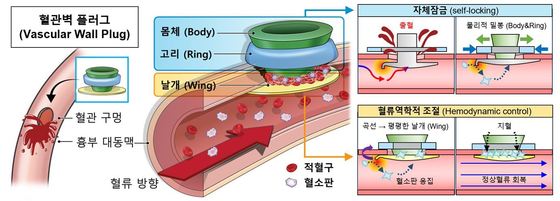
The research team’s breakthrough comes in the form of a vascular wall plug (VWP). This dual-action device physically seals perforations from the exterior while simultaneously modulating internal blood flow to accelerate clotting.
At the heart of this innovation are shape memory polymers. These smart materials expand at body temperature, conforming precisely to the contours of the vascular breach for a secure seal. This adaptability ensures consistent performance, even when deployed by less experienced medical personnel.
The VWP’s design incorporates curved wings at its entry point, a feature that actively promotes hemostasis. This clever configuration encourages platelet collision and aggregation, rapidly forming a natural clot at the site of injury.
To validate their invention, the team conducted rigorous tests on porcine subjects, creating and treating 6mm perforations in thoracic aortas. Follow-up biopsies one month post-procedure revealed tissue regeneration comparable to traditional suturing methods.
Professor Sung emphasized the device’s sophisticated approach: Its innovation transcends simple physical blockage. By harnessing the body’s innate clotting mechanisms, it has significantly enhanced hemostatic efficiency. Extensive large animal trials, mimicking human femoral arteries, have demonstrated that the device matches or exceeds the performance of conventional suturing in both hemostatic efficacy and histological vascular recovery.
This groundbreaking research has been published in the prestigious journal Bioactive Materials, which boasts an impact factor of 20.3.