

K-Biohealth companies are accelerating their push into the global market.
At major healthcare events worldwide, domestic firms are garnering attention not only for their novel drug pipelines but also for their artificial intelligence (AI) powered medical platforms.
Industry reports from Thursday indicate that South Korean pharmaceutical and biotech companies’ technology exports surpassed 20 trillion KRW (approximately 14.1 billion USD) last year, with expectations to exceed this figure in the current year.
South Korean companies are bustling with activity. They’re showcasing AI-based medical solutions at international events, exploring potential partnerships with local healthcare providers and distribution partners.
Recent high-profile events, such as January’s JP Morgan Healthcare Conference in San Francisco and the recently concluded WHX Labs Dubai in the United Arab Emirates (UAE), have provided platforms for these firms to expand concrete business opportunities and validate their commercial potential.
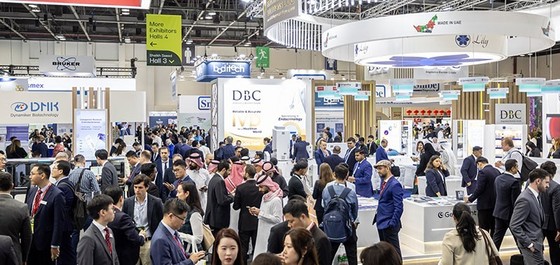
Notably, this year’s WHX Labs Dubai, celebrating its 25th anniversary, saw record-breaking participation with about 850 global healthcare companies from roughly 180 countries. South Korean companies made particularly strong showings at this event.
NGeneBio, an AI precision medicine firm, unveiled its next-generation sequencing (NGS) precision diagnostic software, NGAS (NGeneAnalySys), at WHX Labs Dubai. The company demonstrated its accumulated global operational experience and technological edge.
NGeneBio engaged in meetings with over 70 local medical institutions and global pharma-biotech companies, aiming to establish a global network. During these sessions, they showcased how their platform integrates with hospital workflows and outlined their AI model application roadmap, illustrating the practical applications of their system in clinical settings.
Localized Strategy Accelerates Global Market Penetration
NGeneBio has already deployed its precision diagnostic platform in 28 countries, gaining valuable experience in tailoring systems to diverse healthcare environments. This exhibition serves as a springboard to refine data-driven precision medicine collaboration models for the global market, including the Middle East, and to lay the groundwork for a phased expansion strategy.
Gencurix, meanwhile, honed its global market entry strategy at the JP Morgan Healthcare Conference, the world’s premier healthcare investment event.
During the conference, Gencurix held a series of meetings with industry leaders in the global molecular diagnostics market, including Roche, QIAGEN, and Bio-Rad. These engagements aimed to bolster the company’s foundation for expanding its digital polymerase chain reaction (PCR) based molecular diagnostic products globally.
Neurophet has launched its campaign to capture the North American neurology market.
The company presented its video quantification analysis solution at the 11th American Committee for Treatment and Research in Multiple Sclerosis (ACTRIMS Forum 2026), which brought together multiple sclerosis (MS) and demyelinating disease experts from the U.S. and Canada.
Neurophet plans to leverage this conference to gain insights into North American MS treatment and research trends, while expanding its collaborative network with local medical professionals.
An industry insider commented that South Korean biohealth companies are aggressively showcasing their technological prowess and business strategies at scientific and investment events globally. As they ramp up their international market penetration, they’re optimistic about seeing concrete revenue gains from these expanding overseas partnerships.