Digital health tech firm Welt announced on Tueseday that it plans to complete clinical trials for its insomnia treatment device SleepQ in Germany by year-end, aiming to list it on the Digital Health Applications (DiGA) reimbursement system.
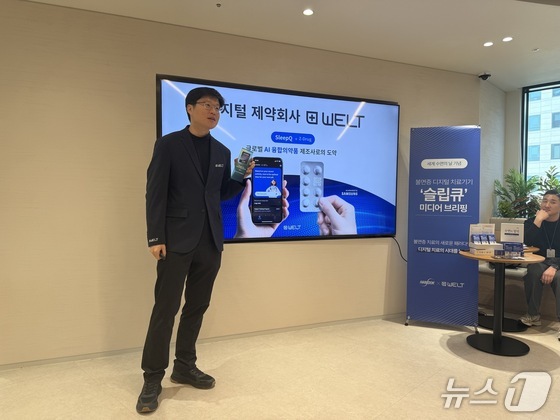
At a press briefing held at Welt’s headquarters in Seoul’s Gangnam district, Chief Executive Officer (CEO) Kang Sung-ji revealed that clinical trials have begun at Berlin’s Charité University Hospital, Europe’s largest university medical center. German authorities have approved the remote clinical trial protocol, allowing us to proceed with patient recruitment, Kang stated.
In February 2024, Welt became the first Asian company to partner with the German Digital Health Association. The firm further solidified its expansion plans by establishing a local branch in Munich in July.
Welt is also eyeing expansion into the Middle East market, having participated in the 2026 Dubai World Health Expo (WHX) this past February.
Founded in 2016 as a Samsung Electronics in-house venture, Welt received a 3 billion KRW (about 2.04 million USD) investment from Handok in March 2021, forming a partnership to jointly develop digital therapeutic devices.
Welt’s flagship product, SleepQ, is an insomnia treatment device that digitally implements cognitive behavioral therapy for insomnia (CBT-I). The smartphone-based app helps correct sleep habits over six weeks through sleep restriction, stimulus control, and cognitive restructuring. In 2023, it became the first innovative medical device to receive approval from South Korea’s Ministry of Food and Drug Safety under the integrated review process.
At the press conference, Dr. Lee Yu-jin, Welt’s Chief Medical Officer, emphasized that cognitive behavioral therapy should be the first-line treatment for insomnia, not medication. However, many doctors are unaware of this, and the reimbursement rates don’t justify the effort involved. SleepQ offers a solution to this challenge.
Since its initial prescription in April 2024, SleepQ has been registered with over 20 general hospitals and 60 specialized clinics. CEO Kang noted that while typical medication adherence rates hover around 60%, SleepQ boasts a 75% compliance rate.
During the briefing, Welt also unveiled SleepQ 2.0, the next-generation version of the device. This upgraded model analyzes users’ sleep patterns to recommend optimal timing for sleep medication intake, maximizing efficacy while minimizing side effect risks.
Riding this wave of growth, Welt is gearing up for a KOSDAQ listing in 2027. The company signed an underwriting agreement with NH Investment & Securities last July.
CEO Kang concluded that the digital healthcare market in South Korea is in its infancy. It’s crucial that we build trust gradually through real-world data and clinical evidence. Welt, in partnership with Handok, is committed to playing a pivotal role in fostering a robust digital healthcare ecosystem in Korea. It’ll continue the development and business operations with a strong sense of responsibility.