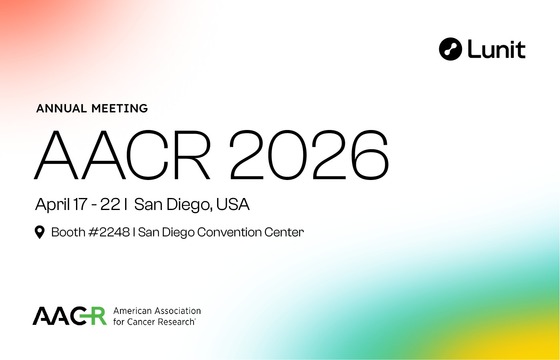
Lunit, a medical artificial intelligence (AI) company, announced on Wednesday that it will present six research findings using its AI biomarker platform, Lunit SCOPE, at the American Association for Cancer Research (AACR) 2026 conference. The event is scheduled to take place in San Diego from April 17 to 22.
The AACR is widely regarded as one of the world’s top three cancer conferences, alongside the American Society of Clinical Oncology (ASCO) and the European Society for Medical Oncology (ESMO). Lunit has been a consistent participant at this event for eight consecutive years since 2019, showcasing research results related to Lunit SCOPE.
In recent months, Lunit has unveiled a series of collaborative research findings with global pharmaceutical giants and leading medical institutions. These studies have demonstrated the potential of AI biomarker technology to significantly impact treatment decisions for cancer patients.
At this year’s conference, Lunit plans to present several groundbreaking studies, including: – A comparative analysis of digital and AI algorithms for quantifying low and ultra-low Human Epidermal growth factor Receptor 2 (HER2) expression in metastatic breast cancer samples – An AI-driven investigation into the relationship between c-MET expression and tumor microenvironment in non-small cell lung cancer – A predictive model for treatment response to tucatinib plus trastuzumab in HER2-positive metastatic colorectal cancer, based on HER2 expression and tumor-infiltrating lymphocytes (TIL) – An AI-powered analysis of tumor-infiltrating lymphocytes (iTIL, sTIL) in non-small cell lung cancer and their correlation with immune checkpoint inhibitor treatment response – The identification of 19 protein co-expression pairs for bispecific antibody development, achieved through AI analysis of millions of immunohistochemistry (IHC) images – A study on biomarkers for predicting drug response in liver cancer patients using AI-based IHC analysis
Seo Beom-seok, Chief Executive Officer (CEO) of Lunit, reflected on the company’s journey, stating that eight years ago, when it first presented at AACR, the challenge was to prove that AI could be applied to cancer treatment. Today, the question has evolved to how far it can push the boundaries with AI biomarkers. He added that they’re committed to accelerating both the quality and pace of the research to establish AI biomarkers as indispensable tools in guiding treatment decisions for cancer patients.