

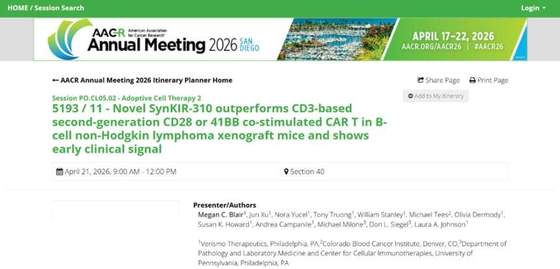
Verismo Therapeutics, a U.S. subsidiary of HLB Innovation, has unveiled promising preclinical study results for its novel chimeric antigen receptor T-cell (CAR-T) therapy, SynKIR-310. The therapy has demonstrated superior anti-tumor effects compared to currently approved CD19 CAR-T treatments for blood cancers.
According to industry reports on Friday, the American Association for Cancer Research (AACR 2026) recently published an abstract detailing these findings. The study, conducted on animal models (NSG mice) implanted with human-derived lymphoma cells, showed that SynKIR-310 outperformed existing CD28-based CAR-T (axicabtagene ciloleucel) and 4-1BB-based CAR-T (lisocabtagene maraleucel) therapies in terms of anti-tumor efficacy and cytokine profile.
SynKIR-310 represents a new generation of CAR-T therapy, employing a multi-chain Killer-cell Immunoglobulin-like Receptor (KIR) based receptor structure. This innovative design separates antigen recognition from activation signals, potentially reducing the risks associated with excessive cytokine release and off-target responses that plague traditional single-chain CAR-T therapies.
Unlike existing CD19 CAR-T therapies that use FMC63, this autologous T-cell therapy targets CD19 using Verismo’s proprietary binder DS191.
The preclinical results were striking: SynKIR-310 achieved a 100% survival rate, standing alone among the comparison group. While the 4-1BB-based CAR-T showed comparable anti-tumor effects and improved survival rates, the CD28-based CAR-T, despite similar T-cell persistence, failed to demonstrate significant effects compared to the control group.
Cytokine analysis provided further insights. Both SynKIR-310 and the 4-1BB-based CAR-T maintained stable cytokine levels throughout the study. In contrast, the CD28-based CAR-T exhibited concerning spikes in cytokine production both early and late in the trial.
Early IL-2 levels skyrocketed to approximately 11 times the baseline, while later stages saw alarming increases in both IFNγ and TNFα, 11-fold and 9-fold respectively. These cytokine surges occurred despite limited tumor control effects.
SynKIR-310 showcased significantly superior tumor control compared to the CD28-based CAR-T while producing lower levels of cytokines. These results suggest that SynKIR-310 could offer a more effective and safer alternative to existing CAR-T therapies.
Currently, SynKIR-310 is being evaluated in a Phase 1 multicenter clinical trial across the U.S. The study focuses on patients with relapsed or refractory B-cell non-Hodgkin lymphoma (B-NHL).
Dr. Laura A. Johnson, Chief Scientific Officer (CSO) and Chief Operating Officer (COO) of Verismo Therapeutics, hailed the AACR 2026 presentation as a watershed moment. She stated that this marks a critical turning point in demonstrating the clinical potential of the multi-chain KIR-CAR technology. By leveraging a more natural immune cell structure, they’re transcending the limitations of existing single-chain CAR-T therapies.