Coreline Soft, a medical artificial intelligence (AI) company, announced on Monday that it has implemented its AI solutions at Charité University Hospital, a leading academic medical center in Germany.
Charité University Hospital is Germany’s premier public teaching hospital. It plays a pivotal role in validating and disseminating national health policies and clinical guidelines through its integrated approach to clinical research and patient care.
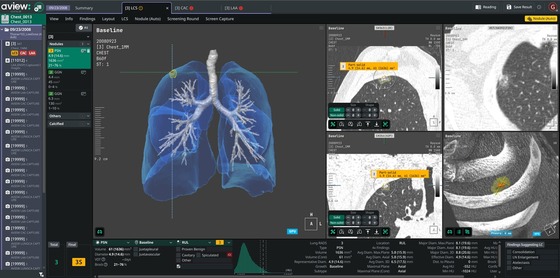
The newly introduced solution, AVIEW LCS Plus, is an AI-powered tool optimized for lung cancer screening using low-dose chest CT (LDCT).
This comprehensive system automatically analyzes lung nodules, chronic obstructive pulmonary disease (COPD), and coronary artery calcification (CAC) from a single CT scan. It’s designed to boost both screening efficiency and diagnostic consistency.
The solution has been validated through its use in the HANSE project, Germany’s pilot program for lung cancer screening, demonstrating its effectiveness in multi-center environments and operational stability.
Germany is currently transitioning its lung cancer screening from pilot programs to a nationwide initiative. The Federal Joint Committee (G-BA) has proposed including LDCT-based lung cancer screening in the statutory health insurance system. This shift is prompting a market restructuring focused on standardized processes covering patient selection, image interpretation, follow-up care, and quality control.
The competitive landscape for medical AI is evolving rapidly. The focus is shifting from single-hospital analytical tools to robust infrastructure solutions capable of reliably managing screenings across multiple centers and readers.
In response to this trend, Coreline Soft has introduced AVIEW HUB, a centralized management platform for multi-center screening. This platform integrates dual reading systems, interpretation history management, and quality control functions. It aims to streamline workflows for medical staff while ensuring consistent regulatory compliance.
An industry expert noted that as national reimbursement schemes and standardized processes become more established, companies with proven experience in multi-center operations and centralized management capabilities will likely gain a significant competitive edge in the long run.