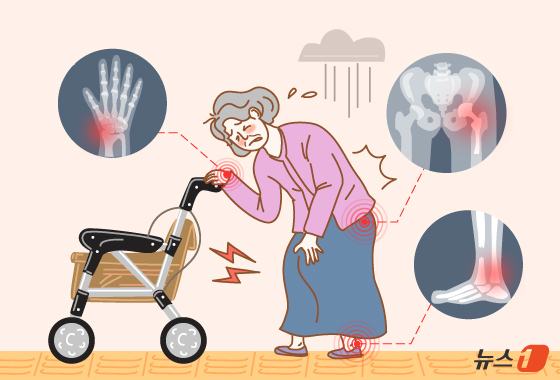
A new study reveals that older adults taking medications for over six months have a 43% higher fracture risk compared to those who don’t.
Researchers from Seoul’s Asan Medical Center and St. Mary’s Hospital tracked 32,771 seniors aged 66 and above who participated in the National Health Screening Program from 2007 to 2008. The findings were announced on Wednesday.
The team found that fracture risk increases with higher levels of anticholinergic components in medications.
These components, common in cold and allergy medicines, as well as treatments for overactive bladder, gastrointestinal issues, Parkinson’s disease, and depression, can cause severe dizziness when accumulated, leading to falls and fractures.
For those with high anticholinergic burden taking medications for over six months, fracture risk soared to 65%.
Patients taking 5-9 medications faced a 29% higher fracture risk than those on 0-1 medications. More medications increase exposure to fall-risk drugs, while common polypharmacy prescriptions like loop diuretics and steroids can raise anticholinergic burden or decrease bone density.
Duration of use proved crucial. Long-term users (over six months) had a 7.8% fracture rate, 43% higher than short-term users at 4.9%.
For anticholinergic drug users, fracture rates jumped from 5.1% for short-term use to 7.8% for long-term use, a 45% increase.
This study highlights duration as a key factor in fracture risk, unlike previous research focusing on drug types and quantities.
Combining duration and anticholinergic burden amplified risks. Even with low burden (KABS 1-2), six-month-plus use increased fracture risk by 55%. High burden (KABS 3+) with extended use raised risk up to 65%.
Hip fractures, often fatal for seniors, showed alarming trends. While medication quantity alone didn’t significantly affect risk, long-term use beyond six months increased hip fracture risk 4.25-fold.
Dr. Son Ki-young emphasized that healthcare providers must focus on reducing both the number of prescriptions and duration of use.
These findings were published in BMC Geriatrics, a respected international journal on aging with a 3.8 impact factor.