Researchers have uncovered the reason why autism, a prominent neurodevelopmental disorder, is more prevalent in males than females.
The Daegu Gyeongbuk Institute of Science and Technology (DGIST) announced on Wednesday that its Center for Synapse Diversity and Specificity has identified a genetic mutation in MDGA1, a key factor regulating neuronal connections and characteristics, as a novel cause of autism spectrum disorder.
Autism spectrum disorder, a significant neurodevelopmental condition, is characterized by deficits in social interaction and repetitive behaviors. It has been observed to occur and be diagnosed in males at rates approximately three to four times higher than in females.
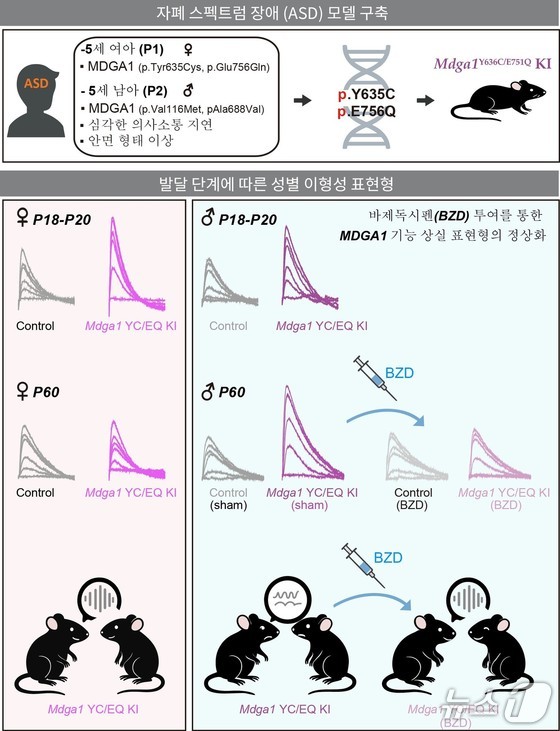
The research team discovered a missense mutation in MDGA1 among patients exhibiting autistic symptoms.
The MDGA1 protein typically functions as a regulator, preventing excessive excitation in brain neural circuits. However, mutations in this gene impair the function of proteins that facilitate signaling between neurons, disrupting the balance of these circuits.
Interestingly, the dysfunction of these brain circuits manifests differently based on sex.
Through experiments, the research team demonstrated that the estrogen signaling system in female mice provides protection against neural circuit abnormalities caused by gene deletion.
Drawing inspiration from this protective mechanism, the team administered Bazedoxifene, a selective estrogen receptor modulator approved by the U.S. Food and Drug Administration (FDA), to male mutant mice. This treatment successfully restored the function of previously impaired neural proteins and normalized atypical behaviors, such as abnormal ultrasonic vocalizations and exaggerated startle responses, bringing them back to standard levels.
Professor Ko Jae-won from the research team stated that this study not only reveals a new genetic factor behind autism spectrum disorder, which has been challenging to pinpoint, but also elucidates the molecular mechanisms underlying sex differences. It plans to continue with follow-up research for potential clinical applications.