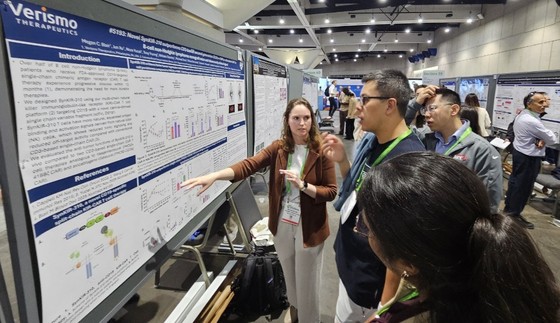
HLB Innovation said on April 22 that its U.S. subsidiary Verismo Therapeutics drew attention at the American Association for Cancer Research (AACR 2026) by presenting preclinical data on its CAR-T therapy for blood cancers, SynKIR-310, in a poster session.
The presentation highlighted that SynKIR-310 demonstrated superior antitumor activity and an improved safety profile compared with existing CAR-T therapies in a mouse model of blood cancer.
Verismo presented the findings on April 21 during the “Adoptive Cell Therapy 2” poster session, with Megan Blair, head of in vivo preclinical research at Verismo, serving as the presenter.
The
SynKIR-310 is a therapy that applies a multi-chain KIR-CAR structure based on natural killer (NK) cell-derived receptors. It separates antigen recognition from T-cell activation signals to implement an on-off mechanism that activates only upon tumor recognition. This design aims to minimize T-cell exhaustion and induce a more sustained antitumor response.
Preclinical results showed that in an animal model (NSG mice) implanted with human-derived lymphoma cancer cells, SynKIR-310 demonstrated enhanced antitumor activity compared with CD28-based CAR-T (axicabtagene ciloleucel) and 4-1BB-based CAR-T (tisagenlecleucel).
In addition, cytokine production was reduced while maintaining a similar level of T-cell persistence. Notably, SynKIR-310 was the only treatment among the comparators to achieve a 100% survival rate. This suggests that multi-chain KIR-CAR may offer a more favorable benefit-risk profile compared with conventional single-chain CAR-T.
The poster presentation also disclosed early data from the ongoing Phase 1 clinical trial (CELESTIAL-301) of SynKIR-310, drawing attention. According to the presentation, a follicular lymphoma patient (a 70-year-old male) achieved complete remission (CR) 28 days after receiving SynKIR-310 at the lowest dose level.
Laura Johnson, chief scientific officer (CSO) and chief operating officer (COO) of Verismo, said, “It is encouraging that SynKIR-310 has demonstrated preclinical results showing increased antitumor activity while reducing cytokine production compared with conventional single-chain CAR-T.” She added, “A case of complete remission has also been confirmed in the CELESTIAL-301 trial, and the fact that the response has been sustained for more than six months is also viewed positively.”