

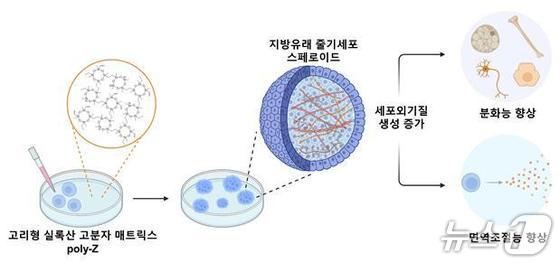
The Korea Advanced Institute of Science and Technology (KAIST) said on April 29 that a research team led by Prof. Jeon Sang-yong in the Department of Biological Sciences has developed a new culture technology that enables stem cells to be grown in a healthier state. The team created a three-dimensional platform by applying a polymer matrix to an “artificial substrate” that mimics conditions inside the human body, allowing human adipose-derived stem cells (hADSCs) to grow in a three-dimensional structure.
Stem cells are undifferentiated cells capable of developing into specific tissues or self-replicating, making them a key component of regenerative medicine.
Stem cells derived from human adipose tissue are considered promising for therapeutic use because they are easy to obtain, proliferate well and have a low risk of immune rejection. However, conventional two-dimensional (flat) culture methods have shown limitations, as cells age over time and lose functionality.
Although three-dimensional culture techniques that grow cells in cluster forms have been studied to address this issue, they have still faced limitations in maintaining long-term survival and function within the body.
To overcome these challenges, the research team developed “Poly-Z,” a synthetic polymer material with densely cross-linked siloxane structures.
This material alters the physicochemical properties of the culture substrate surface, promoting the adsorption of albumin proteins in the culture medium. As a result, cells do not attach to the surface but instead self-assemble into three-dimensional spheroid structures.
Stem cell spheroids formed in the Poly-Z-based three-dimensional culture environment showed increased production of extracellular matrix and demonstrated superior performance compared with conventional methods, closely resembling in-body conditions.

Experimental results showed that stem cells cultured using the Poly-Z-based three-dimensional system exhibited improved differentiation capacity and immune response regulation, along with significantly extended survival time in the body.
In particular, the cells demonstrated more effective therapeutic outcomes than conventional methods in animal models of acute colitis and acute liver injury. This indicates that even when the same number of stem cells is administered, they can survive longer and function more actively, enhancing treatment effects.
The research team confirmed that the technology not only aggregates cells but also creates a “favorable environment” similar to that inside the body.
During this process, integrin proteins, which enable cells to sense their environment, and focal adhesion kinase (FAK) signaling pathways, which convert external signals into internal cellular responses, were activated, strengthening stem cell function.
This means cells can better detect and respond to their surroundings, allowing them to perform their functions more effectively. As a result, cell survival rates after transplantation increased, along with improved therapeutic outcomes.
Jeon said, “This study demonstrates that a precisely engineered three-dimensional culture environment based on synthetic polymers can simultaneously enhance stem cell function and therapeutic efficacy,” adding that it is expected to be widely applied in the development of next-generation stem cell therapies for various intractable diseases, including inflammatory conditions.
The study, with KAIST InnoCORE AI Drug Innovation Research Group researcher Seo Chang-jin as first author, was published online in the international journal Advanced Science.
The research was supported by the interministerial regenerative medicine technology development program, the KAIST InnoCORE program and the National Research Foundation of Korea’s leader research program.