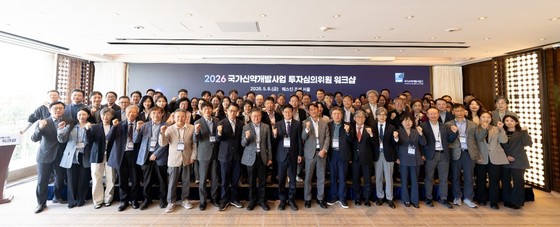
The National New Drug Development Project Group hosted the 2026 Investment Review Committee Workshop at the Westin Chosun Seoul on Friday.
This gathering aimed to share global trends in new drug development markets and investment cases, while discussing criteria for selecting promising projects and future investment review strategies.
The Investment Review Committee evaluates the viability and potential support scale for projects submitted to the National New Drug Development Project from an investment standpoint. The committee is composed of experts from various fields, including drug development, investment, and intellectual property, appointed based on recommendations from key government ministries and relevant academic societies.
Director Park Young-min emphasized that given that the National New Drug Development Project is a large-scale research and development (R&D) initiative funded by taxpayer dollars, the committee’s objective and rational judgment is crucial. It hopes this workshop will serve as a platform to refine the criteria and direction, leading to more strategic project selection and support.
Kim Soon-nam, head of R&D, outlined future plans based on the project overview and operational achievements under the theme National New Drug Development Project Promotion Strategy. Lee Won-jeong, R&D team leader, presented on the comprehensive process of selection, management, and evaluation of investment reviews, along with operational outcomes, focusing on Investment Review Committee Performance and Successful New Drug Project Management Strategies.
Expert lectures provided insights into domestic and international trends in drug development and investment flows. Kim Il-han, director at KB Investment, highlighted recent venture investment trends and key deal cases, shedding light on the evolving landscape of new drug development investments.
Park Chan-hee, Chief Strategy Officer (CSO) of Noveltie Nobility, stressed that new drug development projects must align with global market demands in terms of development strategies and data packages. He emphasized the importance of being prepared for immediate review and collaboration discussions with key partners.
The subsequent panel discussion explored the role of the Investment Review Committee and sustainable support measures beyond the National New Drug Development Project.
As the project group enters Phase 2 this year, they will focus on enhancing the qualitative competitiveness of supported projects and bolstering support for clinical stage initiatives. The group aims to accelerate project outcomes by concentrating resources on high-potential projects and expanding artificial intelligence (AI)-based drug development support.
In a related development, the National New Drug Development Foundation recently inked a memorandum of understanding with Bayer Korea. This partnership aims to boost the global competitiveness of domestic drug development companies and establish an open innovation collaboration framework.
The agreement outlines collaboration in various areas, including creating a support network for the global expansion of domestic pharmaceutical and biotech startups, facilitating the domestic operation of Bayer CoLab Connect, offering strategic consulting to local drug development firms, and fostering connections with international partners and investors.
The foundation, a dedicated national R&D agency, was established to enhance the global competitiveness of the domestic pharmaceutical and biotech industry. It aims to strengthen the local R&D ecosystem and drive global practical outcomes through comprehensive support for new drug development.