

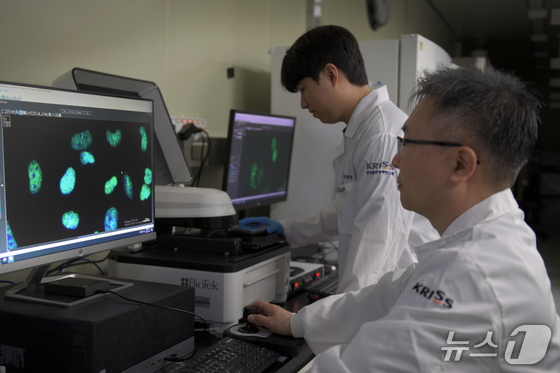
Korea Research Institute of Standards and Science (KRISS) said on the 14th that a joint research team from its Bioanalysis Group and Organic Analysis Group, along with researchers at Wright State University Boonshoft School of Medicine, developed an analytical platform capable of detecting and quantifying ultra-trace damaged DNA fragments generated during the cellular DNA repair process with ultra-high sensitivity.
The technology is precise enough to calculate damaged DNA fragments at the individual-count level and can detect up to 22 times more fragments than existing analytical methods, according to the institute. Researchers said the platform is expected to provide a foundation for studies comparing individual DNA repair capacity and evaluating responses to anticancer drugs and carcinogens.
Human DNA is damaged daily by ultraviolet rays, chemicals, smoking and metabolic activity inside the body. If the damage is not repaired in time and accumulates as mutations, it can lead to aging or diseases such as cancer.
To respond to such damage, cells operate a system known as nucleotide excision repair (NER), which precisely cuts out damaged regions and replaces them with new DNA. Measuring the quantity and timing of the tiny DNA fragments removed during this process allows researchers to accurately identify the speed and efficiency of cellular repair mechanisms. The data can be used as an indicator in studies examining causes of disease and predicting treatment responses.
Until now, there had been technical limitations in accurately quantifying ultra-trace damaged DNA fragments.
Existing methods estimated the total number of fragments by attaching marker substances to the ends of severed DNA fragments and measuring the amount of detected markers. However, if the ends of DNA fragments naturally degraded inside cells over time, the markers could fail to attach properly, causing actually existing damaged fragments to be omitted from analysis.
The KRISS research team addressed the issue by introducing a competitive immunoassay method. The approach uses the principle that target materials in a sample and reference materials compete to occupy limited antibody binding sites. Lower detection signals from the reference material indicate higher concentrations of the target material.
Through this method, the researchers said they secured a world-leading level of precision capable of identifying the actual number of DNA fragments generated inside cells, moving beyond previous approaches that only allowed relative comparisons such as whether DNA repair activity was “high” or “low.”
The researchers said the technology established a foundation for precision medicine research that can objectively analyze DNA repair speed and differences in cellular responses.
KRISS has advanced related research for more than a decade after becoming the first in the world to detect ultra-trace damaged fragments generated during the DNA repair process in 2015. In the latest study, the team redesigned the analytical framework to overcome the fundamental limitations of previous methods.
Choi Jun-hyuk said quantifying DNA repair speed and efficiency could help diagnose individual cancer risks at an earlier stage and objectively identify cancer-cell resistance to anticancer drugs.
He added that the technology could eventually be widely applied to personalized cancer treatment following additional verification using actual human tissue samples.
The study was published in the international life sciences journal Nucleic Acids Research.