

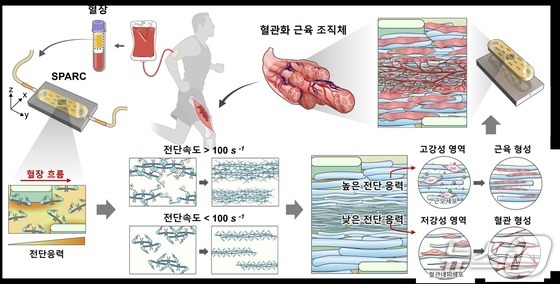
On Wednesday, research teams from Ulsan National Institute of Science and Technology and Yonsei University, led by Professors Kang Joo-hun and Jin Yoon-hee respectively, announced the development of a novel artificial tissue fabrication technology called Shear-induced Patterning of Aligned Regenerative Constructs (SPARC). This technology utilizes fibrin extracted from patient blood to simultaneously regenerate muscle and blood vessels.
This innovative approach addresses the challenges posed by large-scale muscle damage, which often results from trauma or cancer surgeries. Such injuries typically destroy both muscle and vascular tissue, making natural recovery extremely difficult. Traditional treatments have been limited in their ability to simultaneously address muscle alignment and blood vessel formation.
The researchers focused on fibrin, a protein that plays a crucial role in blood clotting. Fibrin is a naturally occurring, protein-based biomaterial that can be extracted directly from a patient’s blood. This makes it an ideal candidate for personalized tissue engineering, as it significantly reduces the risk of immune rejection.
The team developed the SPARC platform, which utilizes micro-pillar structures within microfluidic channels to manipulate shear stress – the force exerted on a surface by flowing fluid. This innovative approach allows for precise control over the tissue formation process.
Within the SPARC platform, areas of high shear stress resulted in densely aligned fibrin bundles, creating an environment conducive to muscle cell differentiation. Conversely, low shear stress regions formed more flexible structures, ideal for the development of vascular networks.
This unique design enabled the simultaneous growth of muscle and blood vessels within a single structure, with each tissue type occupying distinct spatial regions.
The effectiveness of this approach was demonstrated in a mouse model of muscle injury. The engineered tissue successfully integrated with the host’s blood vessels, promoting vascular regeneration and facilitating muscle fiber regrowth. Importantly, the treated mice showed significant improvements in motor function.
The study was published in the online edition of Advanced Materials on April 22. It was supported by various programs from the Ministry of Science and Information and Communications Technology (ICT) and the Korean Research Foundation, including initiatives for mid-career, early-career, and basic research laboratories.
Professor Kang Joo-hun highlighted the significance of their work, stating that the platform uniquely harnesses the alignment properties of fibrin, a single material, in response to external physical stimuli. This approach creates a complex microenvironment that closely mimics natural tissue. It believes this technology has broad potential applications, particularly in treating challenging conditions such as traumatic muscle injuries and tissue deficits following cancer surgeries.