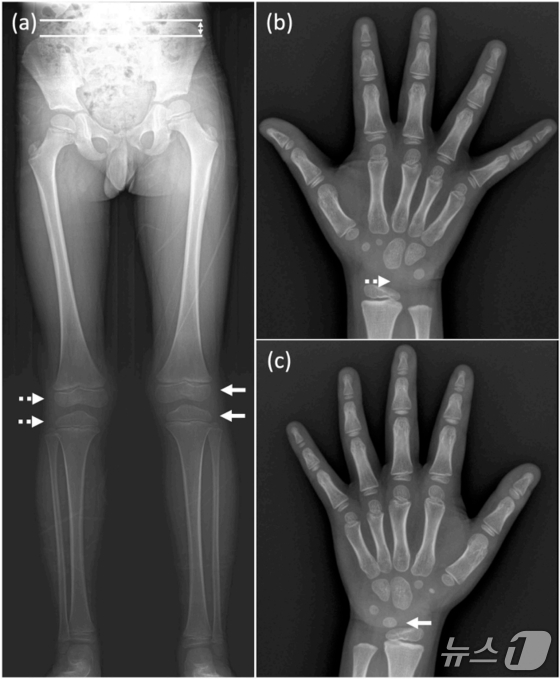
Children with congenital hemihypertrophy — a condition in which one side of the body grows larger than the other — may not only have differences in limb length, but also differences in the rate of bone maturation, with longer bones potentially finishing growth earlier, according to a new study.
A research team led by Prof. Shin Chang-ho of the pediatric orthopedic surgery department at Seoul National University Hospital said on May 28 that it had identified differences in bone age between limbs in 118 pediatric patients with congenital hemihypertrophy and hemihypoplasia. The findings were published in the latest issue of the Journal of Children’s Orthopaedics.
Congenital hemihypertrophy and hemihypoplasia are disorders in which one side of the body grows noticeably larger or smaller than the other, often due to genetic abnormalities such as Beckwith-Wiedemann syndrome or Silver-Russell syndrome. The imbalance can lead to complications including gait disturbances, scoliosis and degenerative joint changes.
Growth plate surgery is commonly used to correct limb-length discrepancies. However, physicians have long questioned whether bone age may differ between a patient’s limbs, though the lack of objective data has meant remaining growth potential was typically estimated using the bone age of only one side.
To address this, the researchers analyzed bone age differences using Korean standard bone-age charts in 118 patients examined at Seoul National University Children’s Hospital between January 2000 and September 2023. The cohort included 34 patients with Beckwith-Wiedemann syndrome, 14 with Silver-Russell syndrome, 14 with PIK3CA-related overgrowth syndrome and 56 idiopathic cases.
The study found that, across the overall patient group, the bone age of the longer arm was on average 1.2 months ahead of the shorter arm. The asymmetry was most pronounced in patients with Beckwith-Wiedemann syndrome. In those cases, the longer leg showed a bone age averaging 7.1 months older than the shorter leg, while the longer arm was ahead by 3.2 months on average.
The findings suggest that differences in bone growth rates are not simply related to anatomical direction, such as left versus right, but are directly linked to disease-related overgrowth itself. By contrast, no statistically meaningful differences were observed in other disease groups, including Silver-Russell syndrome.
The research team emphasized that, rather than estimating remaining growth based on the bone age of only one side, considering the tendency of the longer limb to mature more quickly could help physicians more precisely time surgeries and significantly reduce the risk of overcorrection or repeat procedures.

Prof. Shin said treatment for limb-length discrepancies should involve evaluating not only the difference in length, but also which side’s bones are maturing more rapidly.
“We hope this study will provide practical evidence for predicting growth and planning surgeries for pediatric patients,” he said.
Congenital hemihypertrophy is an extremely rare disorder, and there are currently no established prevalence rates or official statistics on the number of patients either in South Korea or internationally. The researchers said the study could serve as a basis for more precise, patient-tailored timing of growth plate surgeries.