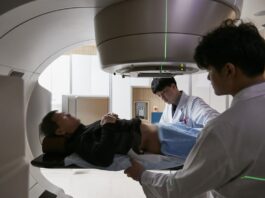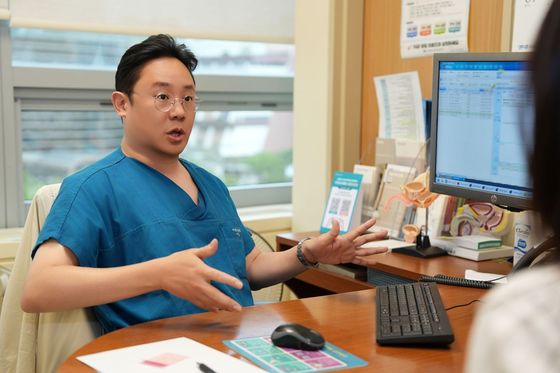
Seoul St. Mary’s Hospital said it has successfully performed robotic surgery for hyperhidrosis using a single-port robotic platform.
The hospital said on May 29 that a team led by Bang Seok-hwan from the Department of Urology successfully treated plantar hyperhidrosis for the first time in Korea on May 18 using a posterior retroperitoneal lumbar sympathectomy performed with the da Vinci SP surgical robot.
Hyperhidrosis is a condition characterized by excessive sweating in areas such as the hands, underarms, and feet. Plantar hyperhidrosis, in particular, causes excessive sweating on the soles of the feet, often soaking shoes even during light activity and increasing the risk of odor and skin disorders.
The condition is caused by overactivity of the lumbar sympathetic ganglia between the second and fourth lumbar vertebrae (L2-L4). Despite its significant impact on patients’ daily and social lives, safe and effective surgical treatment options have not been widely established.
Conservative treatments such as iontophoresis and botulinum toxin injections targeting the nerve-sweat gland junction have been commonly used, but their effects typically last only from several weeks to a few months, limiting their long-term effectiveness.
While surgery offers a more fundamental solution, conventional approaches that pass through the peritoneum carry risks such as bowel adhesions, peritoneal irritation, and longer recovery times.
Laparoscopic surgery, which avoids large abdominal incisions by creating several small ports around the navel, has also been used, but still requires three to four incisions for surgical instruments, leaving concerns over pain and scarring.
The newly adopted approach instead uses a retroperitoneal route that avoids the peritoneal cavity, minimizing such risks. Because the procedure is performed through a single incision, patients are expected to recover and return to daily life more quickly.
Using the da Vinci SP robot, Bang’s team directly entered the retroperitoneal space through a single 2-centimeter incision on the side of the abdomen and precisely identified and removed the L3 lumbar sympathetic ganglion located near the inferior vena cava.
The incision was made along the underwear line near the inner front portion of the pelvic bone to minimize visible scarring. The hospital said the surgery demonstrated that the single-port robotic platform — which allows simultaneous insertion and control of a high-definition 3D camera and multi-jointed instruments through a single 8.5-millimeter cannula — can provide stable visibility and delicate dissection even within the narrow retroperitoneal space.
The hospital added that the Department of Urology’s accumulated experience with retroperitoneal single-port robotic surgery laid the foundation for the successful operation.
A woman in her 20s who visited the outpatient clinic for her first follow-up appointment after surgery on May 27 said she had previously avoided places where she needed to remove her shoes because of excessive sweating. She said the sweating stopped after surgery and that she experienced almost no pain or visible scarring, allowing her to quickly return to normal daily activities.
Bang said the department’s extensive experience and anatomical expertise in retroperitoneal surgery using single-port robotic systems in urology had provided the basis for applying the technique to a completely different condition such as plantar hyperhidrosis.
He added that the team plans to continue clinical research so that single-port robotic surgery can become a new minimally invasive treatment option for patients suffering from plantar hyperhidrosis.
Hong Seong-hoo, director of the hospital’s Robot Surgery Center and a professor of urology, said the case demonstrates that single-port robotic platforms can expand beyond specific organs or diseases to a broader range of conditions sharing the same anatomical space.
He added that the Department of Urology’s experience in minimally invasive surgery is ultimately contributing to improvements in patients’ quality of life.
Seoul St. Mary’s Hospital also recently held a ceremony on May 11 to commemorate surpassing 20,000 robotic surgeries. Of those, 3,798 cases — about 20% — involved single-port robotic surgery. The hospital currently operates five robotic surgical systems simultaneously, including four fourth-generation da Vinci Xi systems and one da Vinci SP system. It has also opened a robotic surgery training center to provide ongoing education for medical professionals.