A groundbreaking study has addressed a longstanding issue in near-infrared medical imaging: the rapid fading of fluorescent dyes used to locate tumors and lymph nodes.
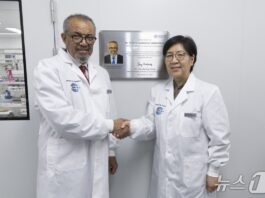
Scientists from the Korea Research Institute of Chemical Technology, led by Drs. Park Young-il and Nam Sang-hwan, in collaboration with Professor Park Sung-jin’s team from Georgia Tech, have engineered a more photostable version of the near-infrared dye indocyanine green (ICG) by restructuring it into a polymer.
Near-infrared (NIR) medical imaging is a cutting-edge technology crucial for precise diagnostics and surgical procedures. NIR light penetrates human tissue more effectively than visible light due to reduced absorption by water and hemoglobin. When combined with fluorescent dyes, this technology can produce images of biological tissues several centimeters deep.
ICG remains the only U.S. Food and Drug Administration (FDA)-approved near-infrared fluorescent dye, with a track record spanning over six decades since its 1959 approval. It’s widely used globally for various medical procedures, including breast cancer lymph node tracking, liver tumor resection, and bile duct visualization. In the U.S. alone, ICG is a key component in more than 750,000 annual laparoscopic gallbladder surgeries.
However, ICG’s effectiveness has been limited by photo-bleaching – the rapid loss of fluorescence when exposed to light – potentially compromising accuracy during extended surgeries. Previous attempts to mitigate this issue through micro-particle or nano-structure encapsulation faced obstacles in manufacturing complexity and fluorescent material leakage, hindering commercial viability.
The research team tackled this challenge by innovatively binding ICG molecules to polymer chains, significantly enhancing the stability and longevity of fluorescent emissions.
The root cause of ICG’s fluorescence loss is the breakdown of its heptamethine ring due to reactions with oxygen when exposed to intense light. The newly developed KR-NIR-P material uses a polymer backbone to shield the chromophore from oxygen. Its structure is further stabilized by hydrophobic interactions between molecules, maintaining fluorescence for extended periods under light exposure. Additionally, the polymer structure prevents molecular aggregation, which can accelerate photo-bleaching.
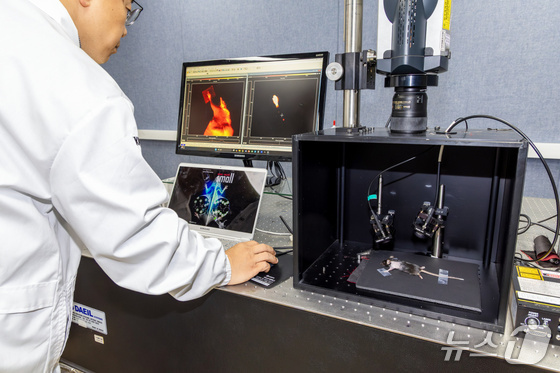
In comparative tests using a 785-nanometer near-infrared laser, traditional ICG showed a sharp 60% decrease in fluorescence within 50 seconds. In contrast, the new material retained 66% of its fluorescence even after 200 seconds, demonstrating over four times greater photostability.
Cytotoxicity tests revealed high biocompatibility, with both cancer cells (cervical and oral squamous) and normal cells maintaining over 90% viability at concentrations up to 20 micromoles (µM). The material showed no significant differences in apoptosis-related protein changes compared to traditional ICG, confirming its non-toxic nature.
The KR-NIR-P demonstrated superior penetration in three-dimensional tumor spheroids, closely mimicking actual tumors. Animal studies with mice further validated its potential for real-time lymph node tracking, crucial for monitoring cancer metastasis.
Looking ahead, the team plans comprehensive preclinical studies, including toxicity assessments and pharmacokinetic research, to establish the safety and efficacy of this innovative material. The researchers anticipate multiple benefits from this advancement, including reduced reliance on imported medical imaging materials, simplified manufacturing processes, and lower healthcare costs due to decreased need for repeated dye injections.
Dr. Park emphasized the significance of their achievement in slowing the light-induced degradation of the chromophore through ICG molecule polymerization.
This groundbreaking research was featured as the cover article in the June issue of Small, a prestigious international journal in nano and micro materials. The study’s first authors include Lee Soo-bin and Choi Min-seok from the Korea Research Institute of Chemical Technology, and Son Young-hoon from Georgia Tech.
The research was supported by funding from the Korea Research Institute of Chemical Technology, the Korea Basic Science Institute, and the Ministry of Trade, Industry and Energy’s Materials and Components Technology Development Program.