

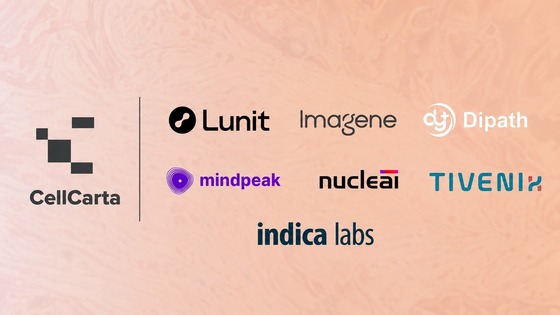
Lunit announced on July 16 that it has joined the ‘AI Consortium for Drug Development, which includes eight global companies specializing in artificial intelligence (AI), digital pathology, and precision diagnostics.
This consortium was launched to support AI-based pathological analysis and biomarker development throughout the entire drug development process, including patient screening, clinical trial operations, and companion diagnostics (CDx) development for global pharmaceutical companies.
Eight companies are participating in the consortium, including Lunit, global contract research organization (CRO) CellCarta, U.S.-based Indica Labs, Germany’s Mindpeak, Switzerland’s Tivenix, Israel’s Imagene and Nucleai, and China’s Dipath.
Lunit will provide AI technologies for immune phenotype analysis, biomarker analysis, IHC quantification, and Hematoxylin and Eosin (H&E)-based tumor microenvironment analysis. CellCarta will oversee clinical trial operations and regulatory compliance, while the other participating companies will contribute their expertise in digital pathology, AI tissue analysis, and liquid biopsies.
Lunit’s Chief Executive Officer (CEO,) Brandon Suh, stated that AI and digital pathology are key technologies for next-generation biomarker development and clinical patient screening. Through collaboration with global companies, it aims to accelerate the development of AI biomarkers and drive innovations in precision medicine.
In related news, Lunit has been selected as the AI solution provider for six regional responsible medical institutions under the AI-Based Medical Support Project promoted by the Ministry of Health and Welfare.
As part of this project, Lunit will supply its chest X-ray AI analysis solution, Lunit Insight CXR, and its mammography AI analysis solution, Lunit Insight MMG, to six medical institutions located outside the metropolitan area. These include Dankook University Hospital, Sejong Chungnam National University Hospital, Ulsan University Hospital, Jeju National University Hospital, Jeonbuk National University Hospital, and Hwasun Jeonnam National University Hospital.