
A next-generation procedure designed to reduce the risk of coronary artery obstruction during repeat transcatheter aortic valve implantation (TAVI) has been successfully performed in South Korea for the first time.
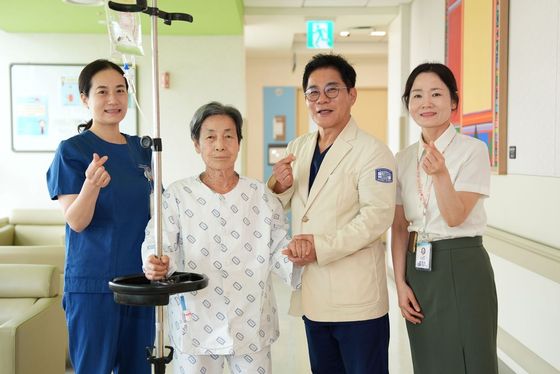
Seoul St. Mary’s Hospital said Tuesday that a team led by Dr. Jang Gi-yuk of the Division of Cardiology at the Cardiovascular Center successfully performed the country’s first LLAMACORN procedure on an 89-year-old woman undergoing repeat TAVI.
TAVI is a minimally invasive procedure that replaces a narrowed aortic valve with an artificial valve using a catheter without opening the chest. As the number of TAVI procedures increases with an aging population, more patients are requiring repeat procedures years later after the implanted valve deteriorates. When an artificial valve degenerates or becomes damaged, a valve-in-valve procedure, in which a new valve is implanted inside the existing one, may be necessary.
One of the main challenges during repeat TAVI is that the leaflets of the existing artificial valve can be displaced by the new valve and block the coronary arteries. Coronary artery obstruction can lead to life-threatening complications, including heart attacks, making advanced preventive techniques essential.
Existing techniques include BASILICA, which uses a guidewire to split the valve leaflet, and UNICORN, which creates an opening in the leaflet to preserve blood flow.
The LLAMACORN technique, performed in South Korea for the first time, is an advanced version of the UNICORN procedure. It creates a small opening in the valve leaflet before using a balloon to completely split the tissue. The technique can be applied to various types of artificial valves and provides a wider channel for coronary blood flow.
The patient had undergone TAVI six years earlier but developed severe aortic stenosis again after degenerative changes in the implanted valve. The medical team decided to use a self-expanding valve because of its hemodynamic advantages but determined that the patient’s low left coronary artery height created a high risk of coronary obstruction during the repeat procedure.
The team successfully implanted the self-expanding valve using the LLAMACORN technique without complications.
An echocardiogram performed the following day showed that the patient’s peak aortic valve blood flow velocity (Vmax) decreased from 4.6 meters per second before the procedure to 2.1 meters per second, returning to the normal range.
“Many patients requiring repeat TAVI after degeneration of an implanted valve face treatment challenges because of the risk of coronary artery obstruction,” Jang said. “The LLAMACORN technique may provide a new treatment option by intentionally removing the valve leaflet to secure a blood flow pathway and reduce that risk.”


