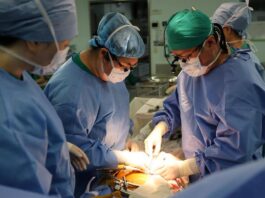
A single-port robotic cholecystectomy performed through a single incision at the navel was found to reduce operating time while maintaining safety comparable to conventional laparoscopic surgery, according to a South Korean study. The findings suggest the procedure could offer a new treatment option that minimizes scarring and tissue damage while improving surgical efficiency.
A research team led by Professors Yoo Young-dong and Choi Yoo-jin of the Division of Hepatobiliary-Pancreatic Surgery at Korea University Anam Hospital said Monday that it had conducted South Korea’s first clinical comparison of single-port robotic and laparoscopic cholecystectomy, demonstrating the safety and efficiency of the robotic procedure.
Cholecystectomy is a surgical procedure to remove the gallbladder, typically to treat conditions such as gallstones and cholecystitis. Laparoscopic cholecystectomy, performed through three to four small incisions, has been the standard treatment.
Single-port surgery has recently gained attention for its potential to reduce scarring and minimize tissue damage associated with surgery. However, laparoscopic single-port procedures have been limited by longer operating times and technical challenges because surgical instruments must be manipulated through a restricted access point.
The research team evaluated the effectiveness of single-port robotic cholecystectomy using the da Vinci SP robotic system, which was developed to address these technical limitations. The da Vinci SP is a single-port surgical system that inserts three multi-jointed robotic arms and a high-resolution 3D camera through a single incision. The robotic arms can move in multiple directions, reducing instrument collisions and enabling more precise surgery in confined spaces.
The team compared perioperative clinical outcomes, including operating time, pain scores, hospital stay and postoperative complications, among 1,184 patients who underwent cholecystectomy between November 2020 and April 2023.
The study found that the average operating time for single-port robotic cholecystectomy using the da Vinci SP system was 40 minutes, shorter than that of conventional laparoscopic cholecystectomy.
There were also no significant differences from conventional laparoscopic cholecystectomy in postoperative pain or the incidence of incisional hernias, confirming comparable safety.
“With three multi-jointed robotic arms and a high-resolution 3D endoscope, the single-port robotic system can overcome the technical limitations of conventional single-port laparoscopic surgery,” Choi said. “This study is significant in showing that single-port robotic cholecystectomy could become a new minimally invasive surgical option that improves surgical efficiency while maintaining safety.”
“We are also experiencing the advantages of single-port robotic cholecystectomy in actual surgical practice,” Choi added. “Based on accumulating clinical experience and research findings, we expect to further expand the application of robotic cholecystectomy.”
The study was published in the March issue of Surgical Endoscopy, an international peer-reviewed journal in the field of surgery.