Moderna and Merck’s collaborative efforts in developing a personalized cancer vaccine have yielded promising results in Phase 3 clinical trials, sparking interest in the South Korean artificial intelligence (AI) driven cancer vaccine companies.
NeoGenLogic, a subsidiary of SCL Science, is at the forefront of this innovation. The company is advancing an AI-powered vaccine design platform that simultaneously analyzes T-cell and B-cell immune responses, with plans to file an Investigational New Drug (IND) application by 2027.
Foreign media reported on Wednesday that Moderna and Merck’s personalized mRNA cancer vaccine significantly extended recurrence-free survival compared to Keytruda monotherapy in a Phase 3 trial targeting high-risk melanoma patients.
This tailored approach involves analyzing genetic mutations in a patient’s tumor to identify cancer-specific neoantigens, which are then used to trigger a customized immune response. The positive Phase 3 results have heightened expectations for the commercialization of personalized cancer vaccines.
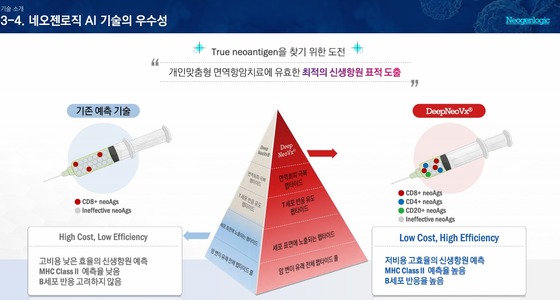
NeoGenLogic has developed two key platforms: DeepNeo, an AI-based vaccine design platform, and DeepDependency, a single-cell big data platform. Both were created in partnership with Professor Choi Jung-kyun’s research team from Korea Advanced Institute of Science and Technology’s (KAIST) Department of Bio and Brain Engineering.
What sets DeepNeo apart is its comprehensive analysis of both T-cell and B-cell responses during neoantigen discovery. The company suggests that this dual stimulation approach could potentially enhance immune response induction compared to conventional methods. Their groundbreaking research has been published in the prestigious journal Science Advances.
Leveraging this technology, NeoGenLogic has secured patents in South Korea, Japan, and China, with ongoing efforts to expand patent coverage to the U.S. and Europe. The company’s roadmap includes non-clinical development of personalized cancer vaccine candidates using its proprietary AI platform, aiming for an IND submission in 2027.
An SCL Science spokesperson emphasized that the successful Phase 3 results for personalized cancer vaccines mark a pivotal moment, signaling the field’s transition to commercialization. It’s committed to advancing NeoGenLogic’s integrated T and B cell AI analysis technology towards IND application by 2027.
NeoGenLogic, as an SCL Science subsidiary, is pushing the boundaries of cancer immunotherapy. The company collaborates with Professor Choi Jung-kyun’s KAIST research team to develop AI-driven neoantigen discovery and cancer vaccine design technologies.
The firm’s flagship platforms, DeepNeo and DeepDependency, underpin its efforts to bring personalized cancer vaccine technology – which analyzes both T-cell and B-cell immune responses – to clinical application.