

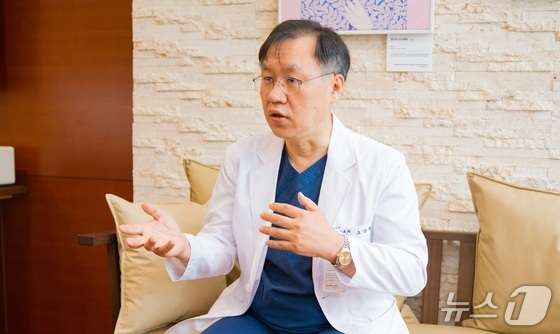
“Somewhere between 0% and 100%, there is always hope. Refusing to give up on even patients with terminal cancer and walking alongside them is the essence of medicine and the spirit that Korea University Guro Hospital’s cancer center has upheld.”
Opening the door to an examination room at Korea University Guro Hospital’s cancer center in Seoul’s Guro district reveals a scene somewhat different from those at other major hospitals. There is no “factory-style care,” in which patients are rushed through a consultation in about three minutes and hurried out the door. When an anxious patient asks questions, doctors may sometimes admonish them firmly, while at other times they hold the patient’s hand and carefully explain the treatment plan.
“I can really feel that when the doctor gets angry because I’m not exercising, it’s because he genuinely wants me to get better.”
These words from a patient visiting Oh Sang-chul, director of the cancer center and a medical oncologist, offer a clear glimpse into his consultation room and the essence of the medicine he strives to practice. Oh emphasizes that “patients can sense a doctor’s sincerity,” adding that “the core of cancer treatment lies not in flashy appearances or outward presentation, but in the fundamentals — the deep trust we give patients and treatment outcomes.”
In 2029, Korea University Guro Hospital is preparing for another major leap forward. With a new 16-story cancer center nearing completion, Oh aims to establish a new paradigm for K-cancer care. We met with him to hear about his vision for the future of cancer treatment and the essence of medicine.
From the Operating Room to Hospice: A “Lifetime of Trust” From Diagnosis to the End of Life
As a medical oncologist who has witnessed countless patients at the boundary between life and death, Oh identifies rapport — a relationship built on trust — as the most important value in cancer treatment.
“When someone is diagnosed with cancer, anyone can be overwhelmed by extreme fear and anxiety. What saves patients at that moment is not simply medication. It is deep trust in their doctor and hospital.”
In fact, Korea University Guro Hospital’s cancer center has numerous long-term survivors who have maintained relationships with Oh for 10 or 20 years or more. It is also common for mothers-in-law and daughters-in-law to receive treatment for colon cancer together, or for children to return to Oh after trusting him with their father’s care.
“There was an 80-year-old patient whose stage 4 colon cancer had spread throughout his body, including to his skin. At the time, his friends would buy him meals and prepare to say goodbye, saying, ‘What a pity.’ But after aggressive chemotherapy, the cancer disappeared as if by magic, and he is still alive at 93. He now has dementia and does not recognize me well, but when his children bring him by the hand and say, ‘This is the doctor who saved our father,’ I feel a profound sense of fulfillment as a doctor, along with the deep emotion of having shared a part of a person’s life.”
Another strength of Korea University Guro Hospital’s cancer center is continuity. Unlike many large hospitals that return patients to the community after surgery or short-term treatment, the center handles the entire process within the hospital, from diagnosis and surgery to chemotherapy, hospice and post-treatment care. Its recently introduced “Cancer Lifetime Management Clinic” has completed a total-care system that continues after cancer treatment, covering recurrence and second-cancer surveillance, management of treatment-related effects, nutrition and rehabilitation, and even cancer prevention management for family members through genetic testing.
“Doctors Take Patients by the Hand to the Next Exam Room”: A True “One-Chair” Multidisciplinary System
Korea University Guro Hospital is a pioneer in multidisciplinary care, having introduced South Korea’s first multidisciplinary breast cancer clinic in 2009. Oh identifies close, patient-centered collaboration among specialists as the core strength of the hospital’s multidisciplinary system.
“When there are too many patients or a hospital becomes excessively large, it is not practically easy to provide in-depth multidisciplinary care to every patient. We, on the other hand, maintain an appropriate scale that allows us to focus on each individual patient and remain faithful to the basics. For example, the internal medicine and surgery consultation rooms at our colorectal cancer center are right next to each other. If the internist determines during a consultation that surgery is urgently needed, instead of making a separate appointment, the doctor may take the patient by the hand directly to the surgeon in the next room and arrange surgery that evening.”
It goes beyond “one-stop” care, in which patients move between departments and change seats. Instead, the patient remains in a single chair — “One-Chair” — while specialists from internal medicine, surgery, radiation oncology, radiology and pathology come together to immediately determine the optimal treatment in a “One-Station” system.
This close-knit, “one-team” collaboration is reflected in treatment outcomes. Korea University Guro Hospital’s colorectal cancer center has raised the five-year survival rate for patients with stage 4 colorectal cancer, for whom survival rates are generally low, to about 45%. The hospital has also maintained the highest grade for five consecutive years or more in quality assessments covering major cancers, including colorectal, stomach, breast and lung cancer.
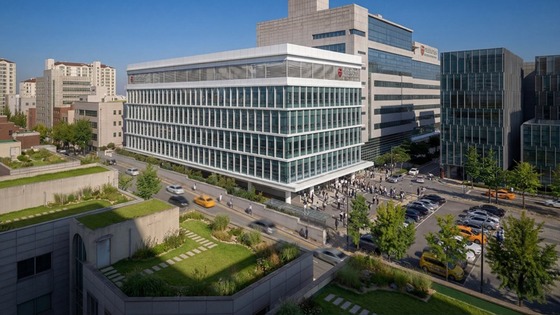
New Cancer Center to Open in 2029, Setting a New Standard for K-Cancer Care
The new cancer center at Korea University Guro Hospital, scheduled for completion in 2029, is a major project combining the hospital’s accumulated strengths in clinical systems and expertise with state-of-the-art infrastructure.
Its capabilities include the world’s first successful robotic lung cancer surgery using a single-port robotic system and its designation as an “Epicenter,” a global training hub. These will be integrated with precision genomics-based personalized cancer treatment and infrastructure including 118 intensive care beds as well as emergency and essential medical services.
But Oh’s vision for the future is not simply to build “the biggest hospital.” Emphasizing “leadership that helps others succeed,” he spoke of creating harmony across cancer care in South Korea.
“Leadership is not about making yourself successful; it is about helping others succeed. K-medicine will not advance simply because one large hospital in the Seoul metropolitan area does well. It is unfortunate that cancer patients in regional areas feel anxious and come to Seoul. We are building networks with regional hub hospitals so that patients can receive the highest level of consultation and the same treatment in their own communities, while sharing technology and expertise.”
“Substance Over Flashy Appearance: Removing Unnecessary Excess and Focusing on Treatment”
Oh also offered his candid assessment of excessive competition over appearances in the medical industry and the financial burden that patients are forced to bear.
“Competition over flashy interiors and enormous lobbies ultimately becomes a burden on the public. We should not have a system in which the retirement savings people have worked hard to build over their entire lives are swallowed up by a single illness and hospital stay. In the movie ‘As Good as It Gets,’ there is a scene in which an artist who was hospitalized after being assaulted by a thief eventually goes bankrupt because of excessive medical bills. We cannot allow that to happen to our cancer patients. Hospitals should not inflate their outward appearance. They should eliminate unnecessary excess and focus on the fundamental mission of treating patients well.”
Just as Korea University’s history has surpassed 120 years, Oh says he wants Korea University Guro Hospital’s cancer center to establish a proper culture of cancer care that can endure for 100 or even 500 years.
“Anyone can face the ordeal of cancer at least once in their lifetime. But these days, cancer is not a death sentence; it is a disease that can be sufficiently controlled. If we do not give up and do our best somewhere between 0% and 100%, miracles can happen. Rather than being a spectacular hospital, we will remain a hospital that patients can trust and come to holding their family members’ hands, a hospital that continues searching for answers together with patients until the end, especially when the cancer is difficult to treat.”