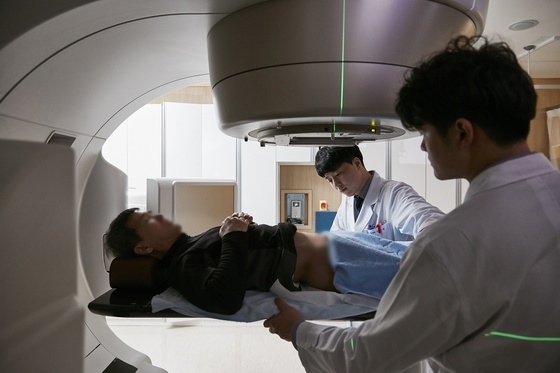
A phase 3 clinical trial found that reducing post-surgical radiation treatments from 33 sessions to 26 provided similar cancer control, potentially easing the treatment burden for patients whose prostate cancer returns.
Asan Medical Center announced on the 12th that a randomized phase 3 clinical trial comparing radiation treatment schedules in 316 prostate cancer patients with biochemical recurrence after radical prostatectomy was published in the Journal of Clinical Oncology. The study was conducted by Kim Young-seok and specialist Song Young-ju of the hospital’s Department of Radiation Oncology, along with Park Won of Samsung Medical Center’s Department of Radiation Oncology.
Prostate cancer is the most common cancer among men in South Korea. Even after the prostate is surgically removed, many patients experience biochemical recurrence, in which prostate-specific antigen (PSA) levels rise again over time. Biochemical recurrence can signal that cancer cells may remain in the body, even when imaging tests show no clear evidence of a tumor.
PSA levels often continue to rise, or recurrence is later confirmed through imaging. In such cases, salvage radiation therapy targeting the area around the surgical site may be administered with the goal of achieving a cure. The standard approach has been to deliver a total dose of 66 gray (Gy) in 33 sessions, with 2 Gy administered per session.
The research team randomly assigned 316 patients who experienced biochemical recurrence after radical prostatectomy between 2019 and 2021 to either a standard-treatment group or a hypofractionated-treatment group. The hypofractionated group received 65 Gy in 26 sessions of 2.5 Gy each, while the standard-treatment group received 66 Gy in 33 sessions of 2 Gy each. Both groups underwent intensity-modulated radiation therapy (IMRT) and image-guided radiation therapy (IGRT), which uses daily CT scans to verify treatment positioning. Outcomes were compared after approximately five years of follow-up.
After about five years of follow-up, the two treatment approaches showed no clear difference in their key measure of cancer control. The four-year biochemical progression-free survival rate, the primary endpoint, was 80.1% in the hypofractionated radiation group and 78.1% in the standard-treatment group. The proportion of patients who remained alive without a renewed rise in PSA levels was therefore similar with the shorter treatment schedule.
The rates of survival without cancer spreading to other organs were also comparable. The four-year distant metastasis-free survival rate was 91.7% in the hypofractionated group and 91% in the standard-treatment group. The four-year prostate cancer-specific survival rate was 100% in both groups. Reducing the number of treatments also did not affect quality of life. Questionnaires assessing gastrointestinal and urinary symptoms showed no significant differences between the groups.
Some differences in side effects were observed, however. Moderate gastrointestinal side effects, including rectal bleeding, were temporarily more common in the hypofractionated group, affecting 7.6% of patients. No severe side effects occurred, and the symptoms were mainly observed in patients who did not use an endorectal balloon. By the final follow-up, all of these side effects had resolved.
The research team said the findings could help reduce the treatment burden for patients who experience biochemical recurrence after prostate cancer surgery. Under the standard approach, patients must visit a hospital daily for six to seven weeks to receive 33 radiation sessions. Reducing the schedule to 26 sessions would cut the total by seven. Patients could save time and money, while hospitals and clinics could use radiation equipment and staff more efficiently.

More than 8,000 radical prostatectomies are performed annually in South Korea. Wider adoption of hypofractionated radiation therapy could therefore be expected to save more than $3.3 million a year in national health insurance spending. Kim said, “The findings show that cancer control and quality of life can be maintained even when the number of treatments is reduced.” He added, “However, precise image-guided treatment and rectal protection are important for reducing gastrointestinal side effects.”