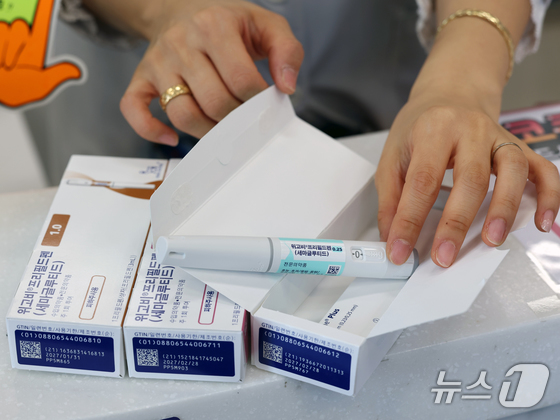
The Ministry of Health and Welfare is launching on-site investigations into medical facilities suspected of violating the separation of prescribing and dispensing principles by preparing and selling self-injectable obesity treatments in-house.
The ministry announced on Thursday that it will be teaming up with local governments to verify compliance with these principles at medical institutions nationwide that supply large quantities of self-injectable obesity medications.
Self-injectable medications are prescription drugs designed for patients to administer on their own. Current pharmacy laws stipulate that pharmacists should prepare and dispense these medications to patients based on a doctor’s prescription. However, exceptions are made when medical facilities directly administer injections to educate patients on proper injection techniques.
The ministry has previously clarified that in-house preparation and sale are only allowed when medical institutions directly administer injections for educational purposes.
Last September, the ministry reinforced this stance by issuing official notices to medical institutions and local governments, emphasizing the requirement for external prescriptions for self-injectable medications.
However, recent reports suggest that some medical facilities have been selling significant quantities of self-injectable medications on-site without directly administering them to patients.
In response, the ministry plans to conduct on-site investigations, focusing on high-volume suppliers, to verify injection practices and ensure compliance with regulations on the separation of prescribing and dispensing. Violations will be addressed according to applicable laws.
Violating Article 23, Section 4 of the Pharmacy Act, which mandates adherence to the separation of prescribing and dispensing principles, can result in up to one year in prison or fines up to 10 million KRW (about 7,570 USD). Breaching the prescription issuance requirement under Article 18, Section 1 of the Medical Law may lead to a 15-day license suspension for a first offense and a 30-day suspension for a second offense within two years.
The ministry will continue to monitor medication supply volumes at medical institutions beyond this investigation and oversee compliance with the separation principles during in-house preparation and sales.
Kwon Soon-hun, Director of Health and Medical Policy at the ministry, stated that while demand for self-injectable obesity treatments is rising, it must not lead to illegal drug sales that violate the separation of prescribing and dispensing principles. It’s committed to strengthening oversight to ensure these principles are upheld, fostering a safe environment for medication use.