

Every time patients arrive in the intensive care unit (ICU) with acute deterioration, there are often subtle signs hours or days earlier hinting at changes in their condition. It’s like recognizing foreshadowing in a drama once you know the ending, explained Dr. Park Yu-kyung, head of the Pediatric Rapid Response Team at Seoul Asan Medical Center.
She emphasized the critical importance of proactive responses in pediatric healthcare.
Adult patients can typically pinpoint their pain, saying something like, the right side suddenly hurts. In contrast, infants and young children often can’t verbalize their symptoms, even with serious conditions like intestinal perforation or acute respiratory failure. Instead, they may only show non-specific signs of discomfort. As a result, medical staff frequently discover alarming symptoms only after the condition has significantly worsened.
Dr. Park noted that children have stricter limits on blood draw volumes and may not cooperate as easily, restricting blood tests and imaging. This is why a proactive intervention system that closely monitors even the slightest changes in vital signs and casual comments from caregivers is crucial in pediatric medicine, she stressed.
Patients on Cusp Between Ward and ICU Care… Developing a Proactive Response System With IT and AI
Advanced general hospitals regularly have high-risk pediatric patients in general wards who need ICU-level monitoring. However, transferring them to the ICU isn’t always the best solution.
When young patients move to the ICU and are separated from their caregivers, their distress can worsen, potentially harming their long-term growth and development, Dr. Park explained. Given the limited number of ICU beds, it faces practical constraints in caring for patients who are less critical but still need close monitoring.
Seoul Asan Medical Center pioneered the implementation of a rapid response team for adults in South Korea. While they previously had a pediatric rapid response team, it wasn’t an independent unit; pediatric ICU (PICU) staff managed both ICU and ward duties, limiting their focus on high-risk patients.
To address this, Seoul Asan Medical Center’s Children’s Hospital has established a dedicated Pediatric Rapid Response Team (PRRT) this year. The team comprises 19 dedicated staff members, including one specialist and 18 nurses. They operate in two groups: the Pediatric Medical Emergency Team (PMET) and the Pediatric Patient Safety and Care Support Team (PACE), ensuring round-the-clock patient safety.
The PMET identifies high-risk patients, conducts at least three daily ward rounds, and provides on-site intensive care for children at risk of acute deterioration.
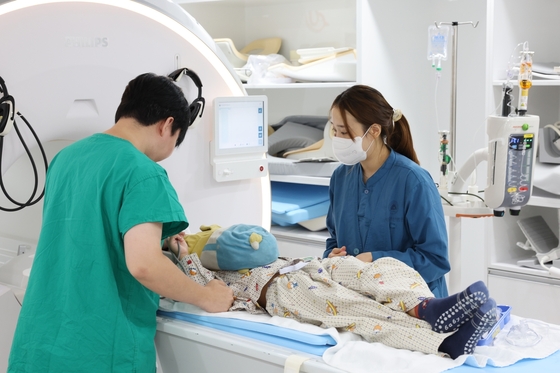
The PACE team handles various medical support tasks, including in-hospital patient transfers, sedation administration and monitoring during procedures, catheter insertions, and ECG tests. The two teams work in tandem, with PACE assisting PMET during critical interventions and sharing pre-procedure evaluations to prepare for potential complications.
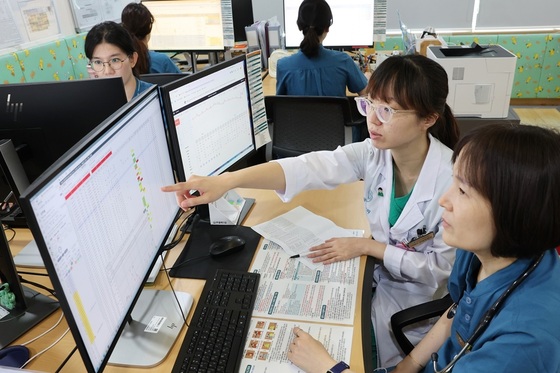
At the heart of this collaborative effort is an electronic monitoring system that detects early risk signals. Recognizing that normal vital sign ranges vary with age in pediatrics, the PRRT continuously monitors values through a filtering system integrated into the electronic medical records (EMR). The team reviews an average of 182 patient records daily.
For example, Dr. Park explained, if a baby’s systolic blood pressure drops below 60 mmHg and the nurse enters this into the EMR, the team, monitoring the electronic screen, will immediately conduct an in-person assessment and intervene within an hour.
However, they face challenges with false alarms triggered by simple fussiness, measurement errors, or medication administration unrelated to the patient’s actual condition. To address this, the PRRT employs both in-house electronic systems and external artificial intelligence (AI) analysis using deep learning to improve screening accuracy. They prioritize patients transferred from the ICU to general wards within the past 48 hours, as well as those with respiratory risks, such as airway deformities or those using home ventilators, high-flow nasal cannulas (HFNC), or tracheostomy tubes.
ICU Readmission Rates Plummet By 81.6%… Next Challenges: Ensuring 24/7 Care and Real-Time Monitoring
Since launching the independent response team, safety indicators have markedly improved.
A standout achievement is the 81.6% reduction in ICU readmissions within 48 hours for patients transferred to general wards, comparing January (pre-team implementation) to February-June data.
Dr. Park explained the stark contrast between ICU and general ward care: In the ICU, one nurse typically oversees two to three patients, allowing real-time monitoring. In general wards, each nurse is responsible for more than double that number, making constant monitoring impossible. She added that PMET now registers transferred patients for at least two days of management, conducting regular rounds, reviewing records, providing nursing care, and educating caregivers – effectively bridging the gap between ICU and ward care.
The PACE team has also excelled in supporting sedation procedures and tests. In the first half of this year alone, they assisted in 4,180 sedation procedures without a single patient safety incident.
They’ve also had success in securing critical golden hours during emergencies. For instance, congenital heart disease patients can experience sudden, dangerous drops in blood pressure and oxygen saturation. Typically, preparing an ICU bed and transferring these patients takes one to two hours – a period when cardiac arrest risk is extremely high.
In such crises, Dr. Park noted that PMET responds immediately on-site, providing respiratory support, administering sedatives and vasopressors, and stabilizing the patient until ICU transfer is possible.
Despite these successes, staffing shortages and systemic limitations persist. PMET’s dedicated physician is only present during weekday daytime hours, while a single dedicated nurse manages both monitoring and PACE duties at night.
Dr. Park voiced her concern: When critical patient care extends into the night, it can delay EMR alert responses and support, challenging the ability to maintain continuous care.
To overcome delays associated with manual EMR inputs, the hospital is preparing to introduce real-time vital sign monitoring in select wards.
Dr. Park concluded that implementing real-time monitoring and increasing dedicated staff will significantly enhance the proactive intervention capabilities. It’s committed to continually strengthening the patient safety system to catch even the smallest risk signals.