

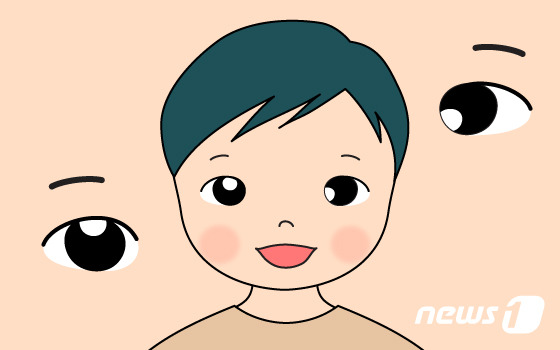
If a child struggles to make proper eye contact with their parents or one eye repeatedly turns outward, the behavior should not be dismissed as a habit. Childhood strabismus is more than a cosmetic concern; it is a condition that can affect visual development.
If treatment is delayed, a child may not use one eye properly, potentially leading to amblyopia, or lazy eye. The ability to perceive depth and see objects in three dimensions with both eyes may also deteriorate. Because most visual sensory functions and eyesight develop by ages 6 to 7, careful observation by parents and early diagnosis are crucial.
Early Detection Matters: Regular Eye Exams for Five Years Are Recommended
Strabismus occurs when the eyes point in different directions. When one eye looks straight ahead, the other may turn inward, outward, upward or downward. The misalignment may be constant or appear only in certain situations. When the angle of deviation is small or the symptoms occur intermittently, parents may have difficulty noticing them, potentially delaying diagnosis.
Intermittent exotropia is common in East Asian populations, including South Korea. In this condition, the eyes are usually aligned, but one eye turns outward when a person looks at distant objects, feels sleepy or tired, is unwell, or stares blankly into space.
Parents should consider having their child evaluated for strabismus if the child turns their head to view objects from an angle, tilts their head to one side, watches television unusually close to the screen, or frequently closes one eye in bright sunlight. An eye examination should be arranged as soon as possible.
“Unlike physical growth in height, visual sensory function and eyesight are largely established by ages 6 to 7, making early detection important,” said Lim Hye-bin, an ophthalmology professor at Incheon St. Mary’s Hospital of the Catholic University of Korea. “As smartphone use increases, previously hidden strabismus may become noticeable or existing symptoms may worsen, so screen time should be managed appropriately.”
The causes of strabismus have not been clearly established, and there is no specific way to prevent it. Factors that may contribute include refractive errors, congenital cataracts, retinal diseases, brain disorders, trauma and family history. Although smartphone use cannot be definitively identified as a direct cause of strabismus, prolonged screen use is a habit that should be managed.
Infantile esotropia, which develops within the first six months of life, requires early treatment. The condition is characterized by one or both eyes turning inward. If left untreated, the eyes may fail to focus together, interfering with the development of depth perception. Because stereoscopic vision begins developing around six months of age, surgery is generally considered between 6 and 18 months of age.
Diagnosis involves a comprehensive assessment of visual acuity, refractive status, the angle of strabismus, eye movements and binocular visual function. Doctors examine when symptoms first appeared and how frequently they occur, as well as checking for a family history of the condition. They then measure the angle of deviation to determine the type and severity of strabismus.
Treatment depends on the type and severity of the condition. Initial approaches may include corrective glasses or occlusion therapy, in which one eye is covered to encourage use of the other. In some cases, botulinum toxin injections may also be considered. If the deviation is substantial or cannot be corrected with nonsurgical treatment, surgery may be performed to realign the eyes by repositioning or removing part of the extraocular muscles.
“It is important to obtain an accurate diagnosis early rather than assume childhood strabismus will resolve on its own as the child grows,” said Ha Seok-gyu, an ophthalmology professor at Korea University Ansan Hospital. “With treatment at the appropriate time, the chances of preventing amblyopia and allowing normal development of binocular vision are higher.”
Strabismus surgery may correct the condition in a single procedure, but the misalignment can recur and require additional surgery. Redness and double vision may occur after the operation, and regular follow-up examinations are essential. Professors Lim and Ha recommend routine eye examinations for approximately five years after surgery.
Although there is no definitive way to prevent strabismus, routine health screenings for infants and young children, combined with parental attention, can help identify warning signs early and improve treatment outcomes. If a child’s eyes appear misaligned, parents should seek evaluation by an ophthalmologist rather than wait in the hope that the condition will improve with age.