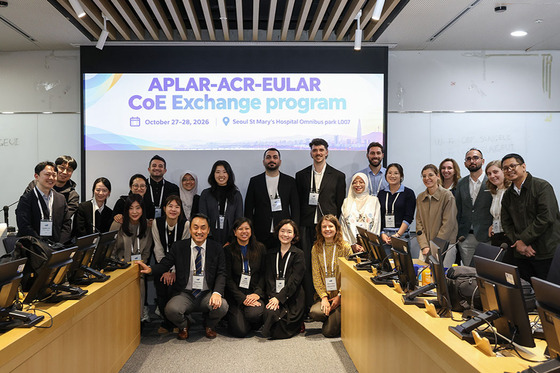
On October 27 and 28, the Rheumatology Center at Seoul St. Mary’s Hospital hosted an international training program at Omnibus Park within the hospital complex. The program was designed for overseas rheumatology specialists and researchers.
The training attracted over 20 young rheumatology specialists and postdoctoral researchers from Europe and the Asia-Pacific region, including participants from the UK, Italy, Turkey, Romania, and Ukraine.
The program was organized based on the Rheumatology Center’s prestigious status as an Asia Pacific League of Associations for Rheumatology (APLAR) Center of Excellence. The center proudly celebrates its 10th anniversary this year, having been the first in South Korea to receive this esteemed designation in 2016.
During the training, attendees were exposed to a wide range of research achievements, spanning from basic research on autoimmune diseases to cutting-edge drug development.
Autoimmune diseases occur when the body’s defense system mistakenly attacks its own healthy tissues instead of protecting against external pathogens. For instance, lupus can affect multiple organs, including the skin, joints, kidneys, and heart. Sjögren’s syndrome, another autoimmune condition, targets tear and salivary glands, resulting in dry eyes and mouth.
Professor Kwak Seung-ki presented groundbreaking research on lupus disease mechanisms and potential therapeutic targets through microbiome studies. Professor Joo-ha Lee shared insights from the KISS cohort study, which examined the unique clinical characteristics of Korean patients with Sjögren’s syndrome.
The program also highlighted the growing synergy between academia and industry in rheumatology. Professor Joo Ji-hyun discussed this collaboration, while Professor Cho Mi-ra provided updates on the development of STAT6-targeted therapies for systemic sclerosis.
The event showcased examples of drug development through international collaborative research. Professor Kwak’s team, in partnership with Harvard Medical School, is developing an innovative targeted therapy for rheumatoid arthritis and inflammatory bowel disease. This therapy simultaneously targets interleukin (IL)-6 and IL-23.
Meanwhile, Professor Joo’s team is collaborating with Stanford University School of Medicine to advance universal cell therapies based on low-immunogenic induced pluripotent stem cells (iPSCs). Both research teams have secured substantial national research funding, each receiving up to 7 billion KRW (approximately 5.23 million USD) for their projects.
iPSCs are versatile stem cells created by reverting specialized cells, such as skin cells, to a state where they can differentiate into various cell types. These cells play a crucial role in disease research, drug development, and regenerative medicine.
Participants had the opportunity to tour state-of-the-art facilities, including the Rheumatology Research Center, the iPSC Application Research Institute, and the Catholic Cell Therapy Center, which adheres to Good Manufacturing Practice (GMP) standards. The program also featured an abstract presentation session where researchers shared and discussed their findings.
Professor Kwak emphasized the significance of the event, stating that as an APLAR Center of Excellence, it facilitated direct interactions between young rheumatology specialists from Europe, the Americas, and the Asia-Pacific region. This exchange of cutting-edge research and clinical experiences is crucial for expanding the academic influence of Korean medical expertise in the Asia-Pacific region.