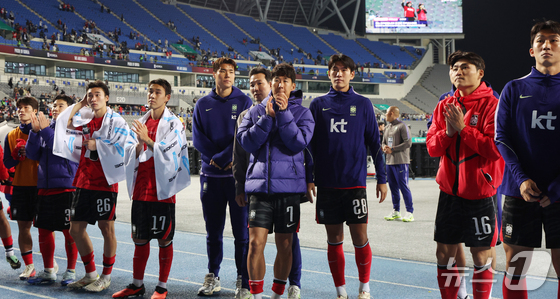
The Moreno-led team concluded their four A-match games in September and October with a record of 2 wins, 1 draw, and 1 loss. Soccer analysts praised the team’s aggressive play style and the promise shown by new players. However, they noted that the execution of the ‘4-4-2’ formation, particularly in midfield control, pressing, and build-up play, still needs improvement. Finding a tactical approach to maximize Lee Kang-in’s abilities also emerged as a key challenge.
Interim coach Roberto Moreno guided the national soccer team to a 2-0 victory against Uzbekistan in a friendly match on Tuesday at Yongin Mir Stadium.
Korea kicked off with a dominant 3-0 win against Ecuador, but then suffered a 1-4 defeat to Uruguay, exposing defensive weaknesses. They followed with a frustrating 0-0 draw against Venezuela before bouncing back with a win against Uzbekistan.
Following the four-match series, commentator Han Jun-hee told News1 on Wednesday that the team showed more initiative compared to previous national squads. They aimed to play in the opponent’s half rather than sitting back. He added taht the performance against Ecuador, in particular, was a definite positive.
Analyst Kim Hwan also noted that it was encouraging to see the team push forward more aggressively. They showed intent to press and attack. He highlighted that the inclusion of younger players has expanded offensive options.
Commentator Park Chan-ha found value in the results. A record of 2 wins, 1 draw, and 1 loss is respectable. Keeping three clean sheets is also a positive sign, he stated. They showed good game management after scoring first, especially against Ecuador.
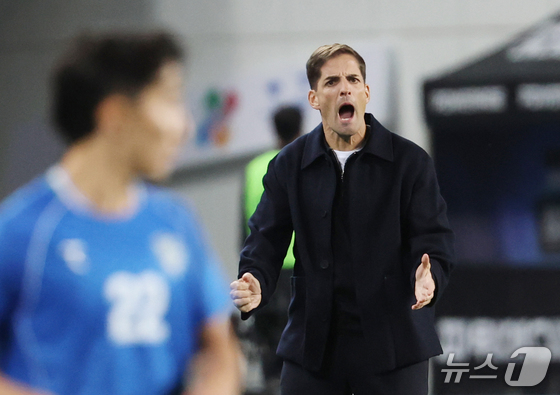
Despite 2 Wins and Three Clean Sheets, Midfield Cohesion and Pressing Tactics Need Refinement
However, the analysts identified common tactical issues that need addressing.
Han Jun-hee explained that in a 4-4-2, the two central midfielders must balance attack and defense, which proved challenging. He noted that during build-up play, the midfield lacked numbers, resulting in disjointed passing and difficulty transitioning to defense after losing possession.
They particularly highlighted the game’s shift when Hwang In-beom (Porto) entered in the second half against Uzbekistan.
Han remarked that Hwang In-beom’s introduction added an extra body in midfield, which noticeably stabilized play. He suggested exploring formations like 4-2-3-1 or 4-3-3 to bolster the midfield presence.
Park Chan-ha pointed out the over-reliance on Hwang In-beom as a concern. Hwang’s influence in midfield remains disproportionately high. It saw this pattern in previous national team setups, where midfield effectiveness hinged on his presence. He emphasized the need to address this midfield management issue.
The analysts also stressed the need for improved pressing tactics.
Kim Hwan analyzed that in a 4-4-2, the four forwards must coordinate their movements, spacing, and timing when pressing. If one player misses their mark, it can disrupt the entire defensive shape. Currently, the team shows willingness to press, but lacks organizational quality.
He added that it’s not just about high-intensity running. There needs to be coordinated movement and spacing, with clear triggers for when to increase pressing intensity. He emphasized that if they stick with the 4-4-2, refining this aspect should be a priority.
Park Chan-ha observed that the team’s performance varied significantly from match to match.
He said that while it must consider Moreno’s interim status, after four games, it’s still unclear what playing style he’s aiming to implement. There needs to be more consistency in how players’ strengths are utilized.
Park added that there were concerns about Moreno’s lack of success with previous teams, and these four matches seemed to validate those worries. The performance against Uzbekistan was particularly disappointing. Regardless of other options, he questions whether he’s the right person to develop the national team and deliver results.
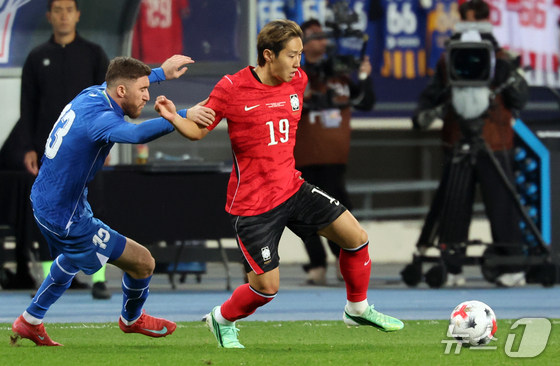
Lee Kang-in: Atletico Madrid Star Struggles to Shine For National Team
Finding the best way to utilize Lee Kang-in remains a crucial task for Moreno.
Han Jun-hee pointed out that isolating Lee Kang-in on the wing limits his effectiveness. It needs to consider positioning another player nearby to allow him more central involvement and increase his touches.
Kim also noted that while using Lee Kang-in centrally is an option, the tactics when he moved inside were underwhelming. He suggested that it could assign Lee a role similar to Lee Dong-kyung’s late in the Uzbekistan match – supporting the striker in attack and pressing as part of a front two when defending.
Through these four matches, Moreno’s team demonstrated an aggressive approach and uncovered potential in new players. However, challenges persist in midfield balance, pressing coordination, and build-up consistency. Finding the optimal role for Lee Kang-in also remains unresolved.
The upcoming November international break will be crucial in assessing how well the team has addressed these issues. Moreno’s next challenge is to refine the playing style attempted in these four matches into a cohesive model and expand tactical options that maximize the players’ strengths.