North Korea has launched its largest domestically built destroyer to date. Named Choe Hyon, this vessel can fire both ballistic and cruise missiles, indicating its potential use as a maritime nuclear strike platform.
The Rodong Sinmun, the official newspaper of North Korea’s ruling Workers’ Party, reported on April 26 that the launch ceremony for the newly constructed destroyer took place at the Nampo Shipyard on April 25, coinciding with the anniversary of the Korean People’s Revolutionary Army’s founding.
The Choe Hyon displaces 5,000 tons, making it the largest vessel in North Korea’s fleet. Typically, ships between 1,500 and 4,000 tons are classified as frigates, while those exceeding 4,000 tons are considered destroyers. Previously, North Korea has unveiled combat vessels such as the 1,500-ton Tuman and Amnok classes.
During his speech at the launch ceremony, Supreme Leader Kim Jong Un stated that the vessel is equipped with systems that enhance North Korea’s anti-air, anti-ship, anti-submarine, and anti-ballistic missile capabilities and that it also carries offensive weapons, including supersonic strategic cruise and tactical ballistic missiles, enabling it to conduct multi-purpose surface operations.
Unlike the Amnok-class frigates, the Choe Hyon is equipped with vertical launch systems and is believed to be capable of carrying land-attack, anti-air, and anti-ship missiles. This development suggests North Korea’s strategic intent to extend its advanced nuclear and missile technologies to naval platforms.
Kim emphasized that the navy’s operational area for defending sovereignty and national interests cannot be limited to territorial waters; naval power must extend into the open seas. He hinted at plans to build a blue-water naval fleet in the future.
He also stated that next year, North Korea will construct similar classes of combat vessels and that the country plans to build larger cruisers and various frigates with enhanced operational capabilities as soon as possible, noting that they are currently in the final stages of reviewing the overall ship designs.
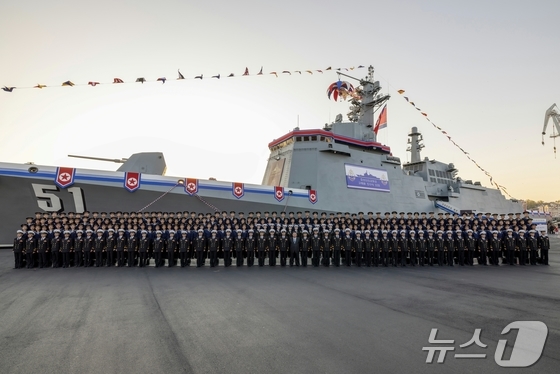
Yoo Yongwon, a member of the National Assembly of South Korea and former military journalist, described Choe Hyon as North Korea’s version of an Aegis destroyer, featuring three vertical launch areas. He estimated it can carry up to ten land-attack ballistic missiles (KN-23 series) and 32 cruise missiles. Yoo added that the vessel also possesses medium- and short-range anti-ship attack capabilities, including North Korean versions of Spike missiles. He stated that if the vessel can also carry the Hwasal cruise missile and the North Korean Iskander (KN-23), North Korea will have a vessel capable of conducting tactical nuclear strikes at sea.
North Korea is already constructing a nuclear-powered strategic guided missile submarine. This submarine is presumed to be capable of launching submarine-launched ballistic missiles (SLBMs) powered by nuclear energy. Kim referred to this submarine as the second signal of naval enhancement, following the destroyer launch.
Choi Il, director of the Submarine Research Institute and a retired naval colonel, identified large vertical launch systems at the bow and stern, estimating around 20 large and 52 small launch tubes. He concluded that the Choe Hyon is more akin to a joint firepower vessel equipped with numerous guided missiles than a traditional destroyer.
He further assessed that the launch of the Choe Hyon signifies a shift in naval operational concepts, moving from small craft to large vessels, coastal defense to offensive capabilities, inshore navy to blue-water navy, and small-scale naval operations to land strike support operations.
The Choe Hyon will be delivered to the navy and enter service early next year. However, U.S. military analysts estimate that significant time will be required for training and familiarization with the new destroyer’s operations before it becomes fully operational.
Choi also noted that if North Korea operationalizes the Choe Hyon-class strategically, it will drastically enhance its land-based nuclear strike capabilities through large vessels. However, he cautioned that the Choe Hyon has significant weaknesses in its primary functions of detecting and defending against aircraft, ships, and submarines. He particularly pointed out that the lack of sonar and torpedo systems for anti-submarine detection and attack could pose a major vulnerability against submarine threats.