

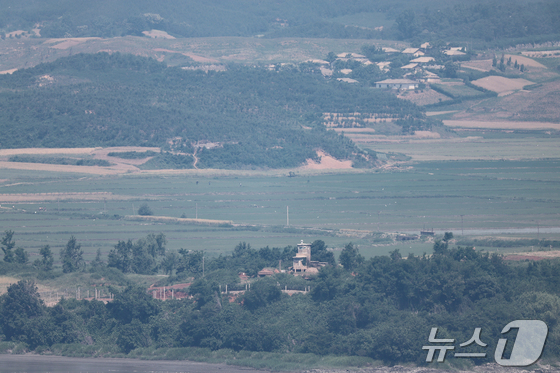
Allegations have surfaced that untreated radioactive wastewater from a uranium refinement facility in Pyongsan County, North Hwanghae Province, North Korea, is flowing into the Incheon area of Ganghwa Island. This has sparked controversy, prompting local authorities to take action to address residents’ concerns.
On Tuesday, officials from Incheon and Ganghwa County reported that the Incheon Institute of Health and Environment plans to begin marine water quality investigations in the Ganghwa area at the county’s request. The study will focus on three locations: the southwestern waters off Jumundo Island, and the eastern and western waters off Gyodongdo Island.
Since Japan began releasing radioactive wastewater from the Fukushima Daiichi Nuclear Power Plant in 2023, the institute has conducted biannual marine water quality tests at five sites. These include the southwestern waters off Jumundo island and four islands in Ongjin County, to monitor for potential contamination that could reach Korean waters via the Pacific Ocean.
In response to recent allegations about North Korea’s discharge of radioactive wastewater into the ocean, the institute has decided to expand its investigation. They will now include the eastern and western waters off Gyodongdo Island, which are located further north than previous sampling sites.
The institute plans to collect 60 liters of seawater from each site to analyze the levels of cesium and tritium.
Researchers have consistently reported that seawater samples collected from the waters around Ganghwa County and Ongjin County have shown cesium and tritium levels below safety thresholds.
An official from the Incheon Institute of Health and Environment stated that they will use Ganghwa County’s administrative vessels to determine the precise seawater sampling points on-site. The institute will begin the investigation by collecting samples from Ganghwa, and later extend the sampling to the Ongjin area.
A Ganghwa County representative stated that they are considering requesting the government to verify whether North Korea is indeed discharging radioactive wastewater into the Yellow Sea, in addition to the marine water quality investigation. The county will promptly share the results of the water quality analysis to alleviate residents’ concerns.
Meanwhile, the Nuclear Safety and Security Commission of South Korea reported that recent measurements from the environmental radiation monitoring network indicated that radiation levels at Ganghwa beach were within the normal range, measuring 0.2 microsieverts (μSv) per hour, which is consistent with natural background radiation levels.