

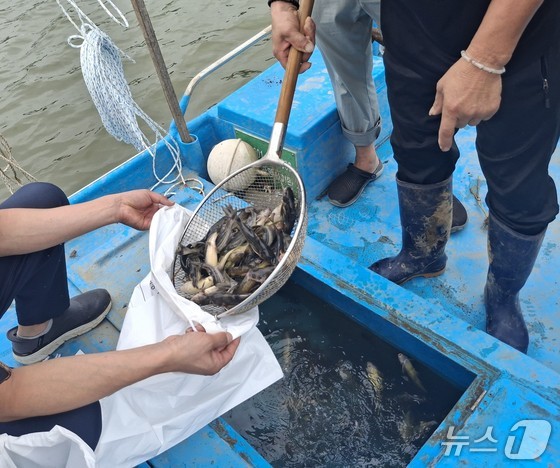
Gyeonggi Province conducted urgent tests for radioactive contamination in seafood from border areas following media reports that untreated uranium wastewater had been discharged from North Korea’s Pyongsan Refinery in Hwanghae Province. The province announced on Tuesday that the test results showed no signs of radioactive contamination.
The Gyeonggi Provincial Research Institute of Marine and Fisheries Resource carried out radiation tests on eight types of seafood over two days, on July 3rd and 4th, in four areas: the upper reaches (Yeoncheon) and the midstream (Paju) of the Imjin River, the lower reaches and the coastal regions (Gimpo) of the Han River.
The species tested included common carp, crucian carp, amur catfish, barbel steed, conger eel, flathead mullet, white-spotted conger, and Korean rockfish. The analysis focused on iodine-131, cesium-134, and -137.
The results revealed the absence of radioactive materials in all samples, resulting in a classification of suitability. This indicates that the seafood from the surveyed areas is free from radioactive contamination.
Kim Seong Kon, director of the Gyeonggi Provincial Research Institute of Marine and Fisheries Resources, stated that the rapid testing of seafood produced in Gyeonggi Province after the Pyongsan Refinery incident has shown that all samples are safe. He further emphasizes their commitment to continue regular and prompt monitoring in areas with potential radiation exposure to ensure public safety.