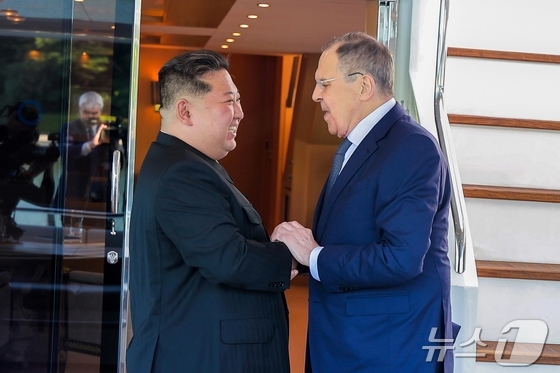
North Korea showcased the strength of its alliance with Russia by reporting on a meeting between Kim Jong Un, General Secretary of the Workers’ Party of Korea, and Sergey Lavrov, the Russian Foreign Minister.
On Sunday, the Workers’ Party’s official newspaper, Rodong Sinmun, reported on its front page that Kim Jong Un had received Sergey Lavrov, who was visiting North Korea to participate in the second strategic dialogue between the foreign ministers of North Korea and Russia. The paper stated that Kim warmly welcomed Lavrov and engaged in a cordial conversation filled with comradely trust.
According to the newspaper, Kim noted that North Korea and Russia agree on all strategic issues, befitting their alliance relationship. The newspaper emphasized that this demonstrates the high strategic level established between the two countries.
The newspaper also published on its front page the full text of a Communiqué on the Second Strategic Dialogue, which appears to be equivalent to a joint press statement.
The communiqué stressed the importance of implementing the treaty on a comprehensive strategic partnership between North Korea and Russia. It stated that both sides reaffirmed their position to deepen strategic communication and cooperation to defend national sovereignty, territorial integrity, and international justice while strengthening cooperation in global arenas.
On the second page, the newspaper provided detailed coverage of the meeting between Choe Son Hui, North Korea’s Foreign Minister, and Minister Lavrov, accompanied by photographs of their talks. According to the report, North Korea hosted a welcoming banquet for the Russian delegation on the evening of July 12th at the Myeongsasimni Hotel in Wonsan-Kalma Coastal Tourist Area.
The newspaper reported that the banquet participants raised their glasses to toast the eternal prosperity of the Democratic People’s Republic of Korea and the Russian Federation, the endless happiness and bright future of the peoples of both countries, and the health of the leaders of both nations. It added that the banquet proceeded in a friendly and convivial atmosphere.
The third page reflected on the stories behind revolutionary educational books published in the 1970s, stating that honoring the history of their leader is the North Korean people’s foremost mission and revolutionary duty. It described these books as the driving force that ignited a surge of rapid progress in socialist construction.
On the fourth page, an article titled “When Ideology is Mobilized, Courage Arises and Paths Open” highlighted workers at the Kujang Cement Factory. It noted that the factory had secured the means to improve cement quality and productivity by independently expanding its cooling system.
The fifth page introduced a People’s Prize-winning work, “Operation to Liberate Taejon,” describing it as a comprehensive and moving portrayal of the unparalleled bravery and mass heroism displayed by the Korean People’s Army soldiers under the brilliant leadership of the Great Leader during the Fatherland Liberation War.
The sixth page reported on news from the General Association of Korean Residents in Japan (Chongryon), mentioning that various regional performing arts troupes from Tokyo, Kyoto, Osaka, and Hyogo are celebrating their 60th anniversary.