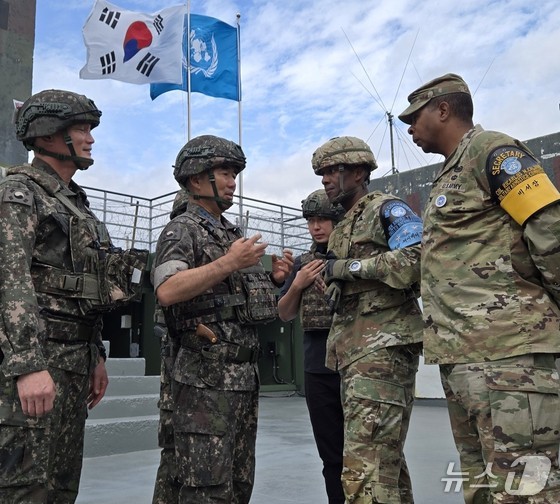
Gen. Jin Young-seung, chairman of South Korea’s Joint Chiefs of Staff, and Gen. Xavier Brunson, commander of U.S. Forces Korea and the United Nations Command, visited a general outpost (GOP) and guard post (GP) along the eastern front on Sept. 9 to assess operations in the Demilitarized Zone (DMZ).
The inspection came as North Korean troops have increasingly crossed the Military Demarcation Line (MDL) in recent weeks, prompting a review of frontline surveillance and defense readiness.
Expressing concern over North Korean activity around the MDL, Jin instructed troops, “This is a period when foliage and frequent fog can make guard operations more difficult, so carefully analyze even the smallest signs to prevent surprise attacks and, in the event of enemy provocation, respond firmly and conclude the operation at the site.”
Brunson emphasized, “The Armistice Agreement has maintained stability on the Korean Peninsula for more than 70 years, and maintaining that stability requires a firm state of readiness. Our presence here together today demonstrates the strength of the South Korea-U.S. alliance and our shared commitment to defending the Republic of Korea and safeguarding peace and stability on the Korean Peninsula.”
According to the military, North Korean troops crossed the MDL about 20 times over roughly one month after first crossing the line last month in the inland eastern front area of Gangwon province. In effect, the incursions occurred almost daily.
The recent increase in North Korean crossings of the MDL is reportedly linked to so-called “borderization” work being carried out in border areas after North Korea defined inter-Korean relations as those between “two hostile states.”
Since North Korean leader Kim Jong Un defined inter-Korean relations as those between “two hostile states” in December 2023, North Korea has been installing fences, minefields and tactical roads around the MDL since April 2024. The Ministry of National Defense estimates the construction will be completed around 2028.
Jin and Brunson agreed that “it is important to continue strengthening the capabilities, readiness and interoperability needed to effectively respond to the changing security environment and maintain firm deterrence while reaffirming that the South Korea-U.S. combined defense posture remains strong.”
Jin inspected the GOP battalion’s surveillance and security operations system and overall response posture, emphasizing, “Considering the threats posed by the enemy, we must establish operational discipline and a command structure and maintain practical operational capabilities and readiness so that all personnel can act immediately as one team.”
The South Korean military is considering installing or relocating additional surveillance assets, including thermal observation devices (TODs), to positions closer to the MDL than their current locations in response to the recent increase in North Korean crossings.