

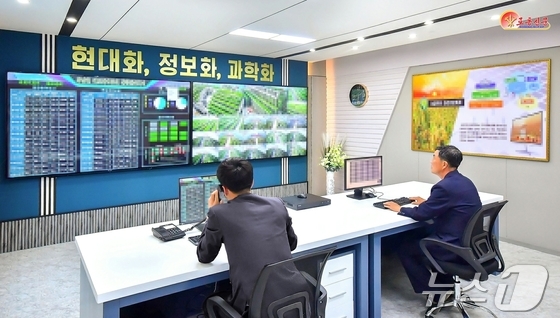
North Korea is expanding its economic transactions through the use of information technology while intensifying state control over its economy, according to a recent analysis.
Choi Ji-young, a research fellow at the Korea Institute for National Unification, argued in a report published on Wednesday titled, North Korea’s Active Economic Management Policies Based on Information Technology: Current Status and Implications, that over the past five years, North Korea’s economic laws and major policy decisions have shown a notable shift in both direction and methods of economic management.
Choi emphasized that the most significant developments in North Korea’s economic management policies over the last five years have been the consolidation of a unified national statistical system and the utilization of economic instruments—such as finance, pricing, and budgeting—to achieve centralized state guidance.
She noted that beginning in 2021, the growth rate of North Korea’s national budget revenue and expenditure plans slowed to around 1%, indicating deteriorating financial conditions. This trend persisted through 2023, prompting ongoing policy measures to leverage financial, monetary, and pricing mechanisms.
Adjustments to fiscal, monetary, and pricing policies are primarily aimed at improving the state’s funding conditions, with information technology serving as a key tool. The 2024 edition of the Laws and Regulations of the Democratic People’s Republic of Korea includes 44 laws incorporating information technology, with 23 laws amended or enacted since 2021 featuring aspects of information technology (IT)—roughly double the previous number.
Choi explained that the integration of information technology into economic laws began following the 2019 amendment to the socialist constitution, which added informatization to the principles of subjectivity, modernization, and scientification of the people’s economy. However, a significant proliferation of such laws occurred only after the 8th Congress of the Workers’ Party in 2021. Consequently, she analyzed that while the overall direction of economic management continues to adhere to the socialist enterprise responsibility management system, it is progressively shifting toward intensifying state control over grain, commerce, and currency circulation.
She underscored the importance of emerging information management platforms. This is evidenced by references to North Korea’s intention to establish various systems—including the price management information system outlined in the Pricing Act, the product registration information system prescribed by the Socialist Commercial Law, the bank electronic payment system under the Electronic Payment Law, and the unified electronic payment center mandated by the Central Bank Law. These laws require suppliers to register prices and product information, while buyers must provide electronic payment details through banks.
Choi concluded that North Korea’s economic management policy objectives may resemble the Soviet Union’s cybernetics experiment, potentially even surpassing China’s electronic payment revolution. Although the current focus appears to be on leveraging information technology to strengthen financial conditions amid prolonged sanctions, she suggests that a North Korean-style market socialism experiment aimed at achieving efficient control and management over the entire people’s economy cannot be ruled out.