

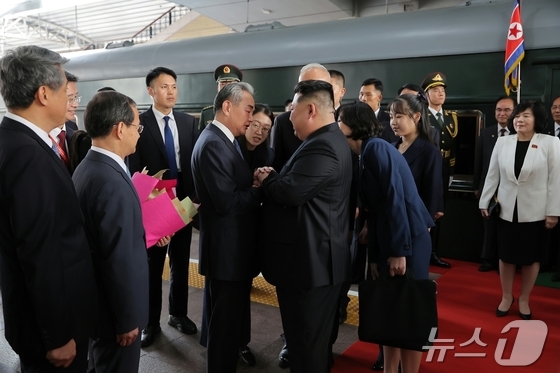
North Korean leader Kim Jong Un’s daughter, Kim Ju Ae, recently accompanied her father on an official visit to China, sparking speculation about North Korea’s potential fourth-generation hereditary succession. While her status as heir apparent remains uncertain, analysts suggest that the succession process appears to be unfolding differently compared to the eras of Kim Jong Il and Kim Jong Un.
On Tuesday, Kim Jong Un arrived in Beijing with his daughter, Kim Ju Ae, to attend China’s Victory Day celebrations, marking the 80th anniversary of the victory in the Anti-Japanese War and the World Anti-Fascist War.
Kim Ju Ae’s presence during this visit to China has reignited speculation that she may have been confirmed as North Korea’s future leader. Traditionally, visits by North Korean leaders and their children to China have been seen as a way of introducing potential successors to the international stage.
However, Kim Ju Ae’s recent actions diverge from North Korea’s past succession patterns. Kim Jong Il, Kim Jong Un’s father, was designated as successor around 1974 but wasn’t officially confirmed until the 1980 Workers’ Party Congress. He then consolidated his power base within the military, party, and cabinet before visiting China in 1983 to meet Chinese leader Deng Xiaoping, Chairman of the Central Military Commission, effectively announcing his succession.
Kim Jong Un’s path to leadership was comparatively shorter. Rumors of his designation as heir began circulating in 2009, and he received official titles in 2010. In 2011, he visited China with Kim Jong Il, introducing himself to the international community in what was viewed as his official debut as successor.
Despite the different timelines, both cases followed a pattern of securing internal legitimacy before making public announcements about succession.
If Kim Ju Ae is indeed North Korea’s heir apparent, her path to succession appears to be significantly different from that of her predecessors.
She first appeared publicly in 2022 at the test launch of the Hwasong-17 intercontinental ballistic missile (ICBM). Her presence at such a significant event, when she was estimated to be about ten years old, shocked the international community. The deliberate showcasing of such a young direct descendant of the supreme leader was considered highly unusual.
In the three years since her debut, she has frequently appeared alongside Kim Jong Un in various public activities. Her recent presence at major diplomatic events has established her as a significant figure, regardless of her actual power. Unlike her father and grandfather, who consolidated internal support before stepping onto the international stage, she seems to be following a reverse strategy—gaining global recognition first before solidifying her domestic position.
This approach may be an attempt to mitigate potential resistance to a female leader within North Korea’s conservative society and elite circles. By presenting her as a figure recognized by the international community, the regime may be trying to address concerns about her leadership preemptively.
However, some experts remain skeptical about her position as the definitive successor. Hong Min, a senior researcher at the Korea Institute for National Unification, cautions against premature conclusions based solely on her frequent public appearances with Kim. He noted that North Korea’s traditional succession pattern—solidifying one’s position into adulthood and gaining domestic approval through party processes—is unlikely to change easily.