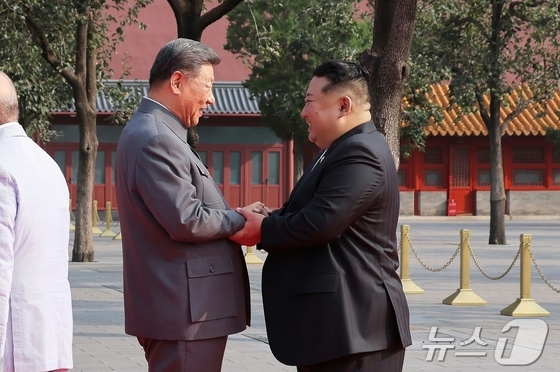
North Korean leader Kim Jong Un’s visit to China was notably accompanied by key economic advisors rather than military personnel. This shift suggests an intention to rebuild the recently strained North Korea–China relationship, starting with economic ties.
According to South Korean government sources, Kim’s delegation on Thursday included his daughter Ju Ae, Foreign Minister Choe Son Hui, Party Organization and Guidance Department head Jo Yong Won, Party Economic Department head Kim Tok Hun, Propaganda and Agitation Department head Ju Chang Il, International Department head Kim Song Nam, and deputy heads of the Propaganda and Agitation Department, Hyon Song Wol and Kim Yo Jong. Also identified were Kim Jae Ryong, head of the Discipline Investigation Department, Kim Yong Su, head of the Finance and Accounting Department, and Kim Byong Ho, deputy head of the Propaganda and Agitation Department.
Notably absent were any military officials, sharply contrasting with Kim’s September 2023 visit to Russia’s Far East. That trip included military leaders such as Park Jong Chon and Ri Pyong Chol, emphasizing military and space cooperation through visits to locations like the Pacific Fleet base and Vostochny Cosmodrome.
This visit’s composition differs from previous trips to China. In January 2019, Kim’s entourage included Party Central Committee vice chairmen Kim Yong Chol, Ri Su Yong, and Park Thae Song, along with then-Foreign Minister Ri Yong Ho and Minister of People’s Armed Forces No Kwang Chol.
The current delegation’s focus on economic advisors suggests that Kim aims to prioritize economic cooperation in his discussions with Chinese President Xi Jinping and accelerate the restoration of economic ties between North Korea and China.
While North Korea’s growing influence and closer ties with Russia have recently overshadowed China’s relationship with Pyongyang, Kim’s decision to lead with economic officials signals a strategic shift to address economic issues first.
This visit may mark North Korea’s adoption of a dual diplomatic strategy: military and security cooperation with Russia, and economic and trade cooperation with China—an approach referred to in South Korea as ‘An-Ro-Gyeong-Jung’—literally meaning security with Russia, economy with China..
Some analysts speculate that Kim might tour Chinese economic and industrial sites. In three of his four previous visits to China, he inspected scientific, technological, and financial facilities, indicating his interest in exploring opportunities for technological and economic cooperation.