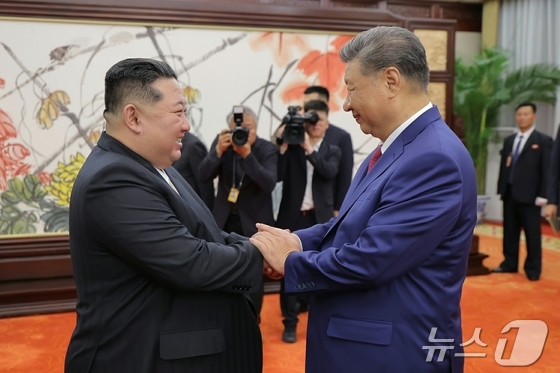
Kim Jong Un, General Secretary of North Korea’s Workers’ Party, may expand his multilateral diplomatic efforts during China’s 80th Victory Day celebrations, which commemorate the end of Chinese resistance against Japanese occupation and the global anti-fascist war. This possibility emerged on September 5, as Kim explicitly mentioned the United Nations (UN) and expressed his intention to strengthen ties with allied nations within a multilateral diplomatic framework.
During talks with Chinese President Xi Jinping on September 4, Kim stated that it highly values China’s fair stance on the Korean Peninsula issue, adding that both sides would effectively safeguard our shared and fundamental interests in multilateral forums such as the UN.
Kim’s decision to explicitly cite the UN as a diplomatic platform marks a significant departure from past practices. Historically, North Korea used the UN primarily to legitimize its regime or defend against diplomatic pressure from other nations, and this statement suggests a complete shift in Pyongyang’s strategy.
Multilateral Diplomacy Signals a Serious Commitment to a Multipolar System… Likely to Deepen the Two-State Framework Between North and South Korea
Kim’s reference to protecting mutual and fundamental interests between North Korea and China in multilateral contexts such as the UN underscores a determination to collaborate with countries like China and Russia to challenge the U.S. unipolar system.
Since Russia’s invasion of Ukraine in 2022, North Korea has strengthened its ties with Moscow, repeatedly emphasizing that transforming the U.S.-centric unipolar system into a multipolar system is a key objective. By standing alongside President Xi and Russian President Vladimir Putin during the Victory Day parade, Kim reaffirmed his commitment to leveraging multilateral diplomacy to diminish U.S. influence.
Given the Supreme Leader’s direct reference to the UN, North Korea’s activities there could intensify, particularly with the upcoming UN General Assembly at the end of this month. Kim is expected to work on strengthening relationships with allied nations, enlisting China and Russia—both permanent members of the UN Security Council responsible for North Korea sanctions—as key partners.
Historically, the UN has served as a diplomatic arena for the U.S., South Korea, and Japan to tighten sanctions against North Korea. Although China and Russia have not always agreed with U.S.-led sanctions against North Korea, their differing stances—China’s desire to save face and Russia’s aggressive posturing following the Ukraine conflict—have prevented these three nations from forming a unified front.
Therefore, the recent agreement between North Korea and China represents a rare moment of alignment among the three countries, which have pursued divergent approaches in recent years. In the future, we might see China taking a more prominent role in leading activities alongside Russia and North Korea at the UN.
Notably, Kim’s praise for China’s fair stance on the Korean Peninsula issue, coupled with his mention of the UN, suggests that North Korea aims to solidify the two-state framework on its only international platform where it can officially engage with South Korea.
Xi’s comment that China consistently supports North Korea in following a development path suited to its circumstances indicates that Beijing has no intention of undermining Pyongyang’s two-state policy. This stance could significantly impact South Korea’s North Korea policy, which does not recognize the two-state framework.
Some analysts suggest that Kim’s reference to the Korean Peninsula issue is aimed at addressing sanctions. It implies that North Korea seeks to elicit a stronger response from China to break the sanctions framework led by the U.S. and its Western allies. This strategy may involve China rallying support from North Korea and Russia against U.S. pressure and military threats, thereby preparing a counter-strategy against Washington.
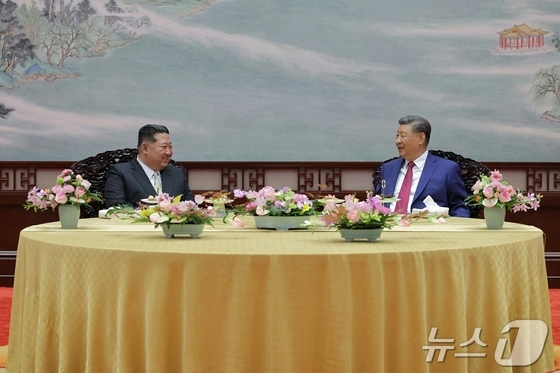
Denuclearization Issue Disappears… Resuming U.S.-North Korea dialogue May Take Time
North Korea and China appear to have entirely omitted the topic of denuclearization during their recent summit. Neither the official meeting results released by China nor reports from North Korea’s Rodong Sinmun mentioned denuclearization.
China outlines its so-called Three Principles for the Korean Peninsula as: 1) Peace and stability on the Korean Peninsula, 2) Denuclearization, and 3) Autonomous resolution through dialogue and negotiation. The absence of denuclearization in their recent discussions could indicate that China chose to omit this point out of consideration for North Korea, or it suggests a potential revision of the three principles.
This stands in contrast to the firm commitment of the U.S. and South Korea to denuclearization as an official stance. In light of ongoing North Korea gestures from the U.S. and South Korea, Pyongyang may have taken measures to ensure it does not stray from dismantling the U.S.-centered unipolar system, as guided by China.
From North Korea’s perspective, Kim may have drawn a line against President Trump’s desire to meet during the Asia-Pacific Economic Cooperation (APEC) summit in late October in Gyeongju. Since Xi is also expected to attend APEC, any U.S. contact involving North Korea would likely cause significant embarrassment for China.
Additionally, the omission of denuclearization has led to interpretations that China has implicitly accepted North Korea as a nuclear state. If true, this increases the likelihood of forming a joint nuclear front among China, North Korea, and Russia against the U.S.
Professor Lim Il-chul from Kyungnam University’s Institute of East Asian Studies commented that China has implicitly recognized North Korea as a nuclear state, ultimately acknowledging the inevitability of nuclear possession.
Senior Research Fellow Hong Min at the Korea Institute for National Unification stated that by altering the three principles, China has effectively shifted its stance to support North Korea’s justification for nuclear possession, while still withholding a definitive position on the adversarial two-state framework between North and South Korea.