North Korean leader Kim Jong Un emphasized on Monday that he could engage in dialogue if the U.S. abandons its denuclearization demands, highlighting his good memories of former President Donald Trump. This statement appears to signal interest in a potential U.S.-North Korea summit while underscoring that a shift in the U.S. stance remains a prerequisite.
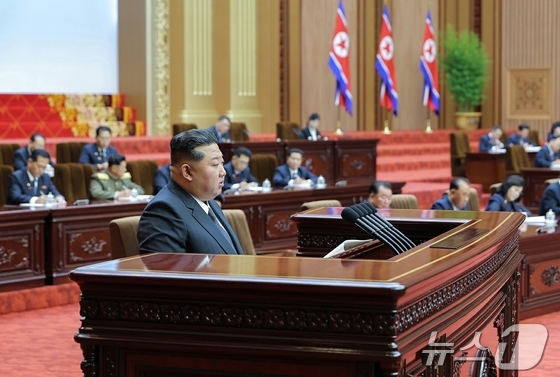
The Workers’ Party’s official newspaper, Rodong Sinmun, reported on Kim’s important speech at the 13th session of the 14th Supreme People’s Assembly. Kim stated that if the U.S. sheds its unrealistic obsession with denuclearization, acknowledges reality, and genuinely seeks peaceful coexistence with us, they have no reason not to engage with them.
Kim notably mentioned that he still personally have good memories of former President Trump, marking the first time he has referenced positive sentiments about Trump and the possibility of a U.S.-North Korea summit since Trump left office.
As President Trump plans to visit South Korea next month for the Asia-Pacific Economic Cooperation (APEC) summit, speculation arises about potential behind-the-scenes communication between North Korea and the U.S. The upcoming 80th United Nations (UN) General Assembly in New York on Tuesday may also provide an opportunity to activate diplomatic channels.
Kim expressed ongoing concern regarding the close ties between South Korea and the U.S. He criticized recent joint military exercises, including Ulchi Freedom Shield and trilateral drills with Japan. Kim alleged that previous U.S. and South Korean administrations had created nuclear operational guidelines premised on using nuclear weapons against North Korea, which he claims the current administration has inherited, leading to more concrete nuclear war planning.
He dismissed the phased denuclearization approach promoted by South Korea and the U.S., declaring that denuclearization has lost its meaning. Kim argued that they have undermined their own justification for dialogue with them, implying that the term denuclearization should be abandoned entirely.
Kim particularly criticized President Yoon Suk Yeol’s recent mention of a three-stage denuclearization plan, dismissing it as a rehash of previous administrations’ failed strategies to disarm North Korea.
Kim justified North Korea’s nuclear status, stating that its transition to a nuclear power was an essential choice made at the crossroads of our nation’s survival. He added that’s why they regard its nuclear arsenal as sacred and absolute, enshrined in its highest law.
He warned that as long as external nuclear threats persist and imperialist forces use nuclear weapons as a means of survival, it will never halt the strengthening of its military power. Further noting that it will continue to build the strength to safeguard its national security and the people’s future.
Kim asserted that the world knows what the U.S. does after disarming nations, reiterating, it will never relinquish its nuclear weapons. He emphasized that North Korea’s nuclear possession is enshrined in national law, creating a legal obligation to maintain it.
Kim stated that its war deterrence is currently in effect, and he hopes its primary mission is not lost, warning, if it is, the secondary mission of deterrence will be activated.
He threatened that if the secondary deterrence mission is activated, the military infrastructure of South Korea and its regional allies will instantly collapse, leading to devastation. This implies that while their current nuclear posture is defensive, it could shift to an offensive stance if U.S.-South Korea aggression intensifies.
Kim unequivocally stated there would be no engagement with South Korea, asserting that for decades, them and South Korea have effectively existed as two separate nations in the international community. He emphasized his refusal to engage in any dialogue with Seoul.
He added that the classification of South Korea as a foreign and most hostile nation is not a sudden judgment, attributing this stance to South Korea’s long history of anti-North Korean actions. Kim squarely blamed South Korea for the deterioration of inter-Korean relations.
Kim concluded by stating that from the perspective of national interests, they have no intention of uniting with a country that entrusts its politics and defense to foreign powers, asserting that the unification of two fundamentally opposed entities can only occur if one ceases to exist.