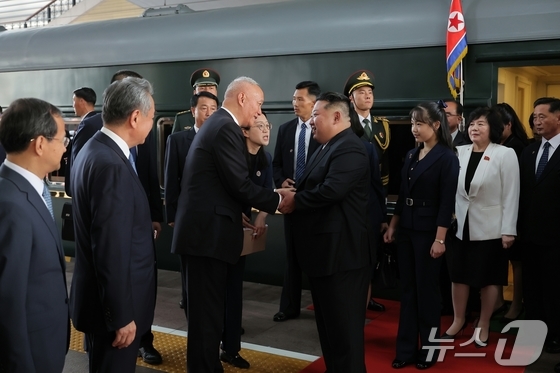
Kim Jong Un, the General Secretary of North Korea’s Workers’ Party, accompanied by his eldest daughter, Kim Ju-ae, visited China on September 2. Her appearance on the international diplomatic stage quickly led analysts to conclude that her status as a potential successor had been reinforced.
The South Korean intelligence agencies informed the National Assembly’s Intelligence Committee that they had ensured Kim Ju-ae gained overseas experience while deliberately keeping her out of major public events. This strategy secured the revolutionary narrative required for her role as a prominent successor during the China visit. Japan’s Asahi Shimbun also assessed that this move was designed to build recognition among North Koreans of Kim Ju-ae as a potential heir.
However, a 50-minute documentary released by North Korean television on Kim Jong Un’s visit to China challenges the idea of Kim Ju-ae making her debut as a successor on the diplomatic stage. The film barely features her activities, showing only a brief glimpse of her arrival in Beijing, a visit to the North Korean embassy, and her return journey to Pyongyang, without any specific titles or explicit mentions.
Kim Ju-ae first gained public attention when former National Basketball Association (NBA) player Dennis Rodman visited North Korea in September 2013. During his stay at the Wonsan villa, he reportedly spent about a week with Kim Jong Un’s family, even holding his daughter.
Nine years later, on November 18, 2022, she accompanied Kim Jong Un to the test launch of the intercontinental ballistic missile (ICBM) Hwasong-17, instantly drawing both domestic and international attention. Since then, she has frequently appeared at military events and expanded her presence into the sports and security sectors.
Initially, analysts suggested that these appearances were part of a political propaganda effort intended to present her as a symbol of the future generation, fueling speculation about her designation as a successor. Her debut was sudden; foreign and domestic media widely reported that a girl seen during the regime’s founding anniversary performance on September 9, 2022, was Kim Jong Un’s daughter. However, North Korea officially revealed the true identity of Kim Ju-ae only about two months later. This series of events does not appear to have been orchestrated as part of a meticulous plan.
Nevertheless, as her participation in official events increased and titles such as beloved child, respected child, and noble one began to be attached to her name, the analysis that she might be a successor naturally spread. Initially, intelligence agencies considered it premature to view Kim Ju-ae as a successor, but by late 2023 they revised their assessment, stating that she currently appears to be a strong candidate for succession. Some speculate that she may not be a successor at all, but rather a decoy to bolster her brother, who is allegedly undergoing successor training behind the scenes.
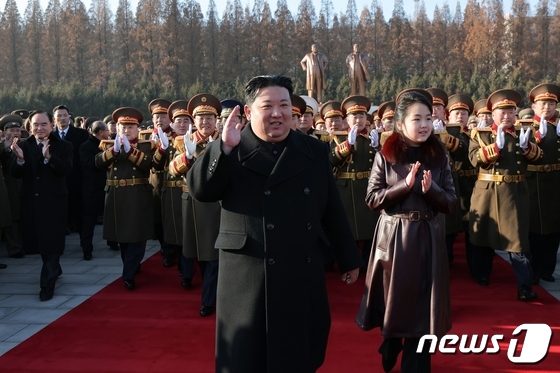
Is Kim Ju-ae indeed being groomed as a successor, as suggested by the international community? To answer this, several key points must be examined.
First, regarding her birth order, there is ambiguity: while she is often considered to be the first child, our intelligence agencies confirmed when she appeared in public in 2022 that she is Kim Jong Un’s second child, additionally noting that he has an older son (born in 2010) and a third child whose gender remains unconfirmed. Kim Jong Un is reported to have married Ri Sol-ju in 2009, with their first child supposedly born the following year. However, given Ri’s confirmed whereabouts around 2009, the likelihood of her giving birth at that exact time appears low.
In 2005, a student named Ri visited Incheon as part of a North-South cultural cooperation group during her first year at Kim Sung University. After graduating in March 2008, she went to study in China (according to North Korean sources) and returned to Pyongyang either at the end of that year or in early 2009. It appears that she was then chosen as the spouse for the future leader, entering formal preparations to become the First Lady.
Upon returning to Pyongyang, she began her singing career by joining the Moranbong Band, debuting at a performance commemorating the 9/9 Day—the founding anniversary of the North Korean regime—in September 2010. On December 31, 2011, she performed a solo rendition of “Soldier’s Footsteps” at the New Year’s concert of the Mansudae Art Troupe.
Notably, both Kim Jong Il and Kim Jong Un attended this concert together. Subsequently, she appeared at a Lunar New Year concert in February 2011, which marked her final performance and solidified her identity as singer Ri among North Koreans. She did not return to the stage thereafter, and it is presumed that she married around that time. A year and five months later, in July 2012, she made her official public appearance as Kim Jong Un’s wife.
Given this background, it is likely that Kim Jong Un and Ri began their married life after February 2011 and welcomed their first child, Kim Ju-ae, in January 2013. The year 2010, when their first son was reportedly born, coincided with Ri’s intensive focus on performance rehearsals. Chris Volo, Rodman’s former manager who visited North Korea four times, stated that he had no opportunity to learn of the existence of Kim Jong Un’s son during his visits. At the time Rodman was with Kim Jong Un’s family, there was no son present. Currently, it seems plausible that Kim Jong Un has three children: Kim Ju-ae, a son born in 2017, and another daughter born a few years later.
Second, in light of the childhood experiences of Kim Jong Il and Kim Il Sung, it is difficult to interpret Kim Ju-ae’s public appearances as part of a formal successor training or designation process. Kim Il Sung took his son, Kim Jong Il, along on visits to the Soviet Union and Eastern Europe during the summer of 1959—when he was in his final year of high school—and later brought him along for military and economic inspections during his university years. His daughter, Kim Kyung-hee, also accompanied him on several occasions in the late 1950s, though her name was not mentioned. In contrast, Kim Jong Il only began occasionally taking his children along for local inspections after Kim Il Sung’s death. Unlike Kim Ju-ae, during the eras of Kim Il Sung and Kim Jong Il, the presence of wives or children on official visits was kept confidential, with photographs or anecdotes released only after they officially assumed roles as successors.
In this context, the public appearance of a child who has not been formally designated as a successor is a phenomenon that only emerged after the establishment of Kim Jong Un’s regime. The policy of publicizing the families of supreme leaders—the so-called Paektu bloodline—appears to align more with the formalization of Ri’s status and the public activities of her sister-in-law, Kim Yo-jong, rather than indicating any specific training or designation for succession. For example, the recent public appearance of Kim Yo-jong, accompanied by her two children during the New Year celebrations on television, serves as a similar instance. The presence of children at official events can be seen as a special privilege granted to the education of the supreme leader’s offspring, rather than as part of a systematic training process following an official designation as a successor.
Third, within North Korea’s system and ideology, the designation of a successor is intrinsically linked to the establishment of a unique leadership framework for the heir. This framework encompasses the ideological foundation, organizational structure, and the business order and discipline necessary to fully realize the successor’s leadership. It refers to the organizational and political arena through which the successor leads the party, state institutions, mass organizations, and the public. Kim Jong Il began to establish his presence within the party in 1967 and only started building this unique leadership system after being officially designated as the successor in February 1974. Similarly, Kim Jong Un only began forming a task force and establishing a unique leadership system after being officially recognized as the successor in January 2009.
If Kim Ju-ae were to be designated as a successor, a supporting system for her political activities would need to be in place—yet no such signs have emerged. In July, multiple Chinese entrepreneurs engaged with North Korea reported that they had never encountered anyone in North Korea who believed that Kim Ju-ae was being groomed as a successor or receiving training for that role, indicating that the issue of succession has not been discussed within the country.
Some experts claim that after the 8th Party Congress in 2021, Kim Ju-ae was informally appointed as the First Secretary, a role serving as a proxy for the General Secretary, but there is no concrete evidence to support this assertion. Notably, there have been no previous instances of North Korea publicly conducting successor training, and according to North Korean successor theory, such training is unlikely to occur anytime soon. The moment a successor is designated, power becomes divided. Therefore, it is premature to conclude that Kim Ju-ae has been designated as a successor until she holds an official position and can publicize achievements both domestically and internationally.
Kim Ju-ae is currently 13 years old, and she must wait at least five more years (until she is 18) to join the Workers’ Party. Her younger brother is only 9. For now, it is more plausible to view her as Kim Jong Un’s cherished daughter and a symbolic figure devoted to the construction of socialism as part of the Paektu bloodline, rather than as a potential successor.
Since the 8th Party Congress, Kim Jong Un has announced a 15-Year Plan aimed at achieving comprehensive socialist development by 2035. Therefore, barring any health issues, it seems unlikely that discussions concerning succession—which could potentially lead to internal political turmoil—will be publicized in North Korea before the 11th Party Congress of the Workers’ Party in 2036. In this regard, the ongoing debates both domestically and internationally about Kim Ju-ae as a successor appear to be both premature and unproductive.