

During the 80th United Nations (UN) General Assembly high-level session, the South Korean government launched an extensive diplomatic effort to push for the suspension of North Korea’s nuclear capabilities development. However, these efforts yielded little result. The government failed to capture the attention of the U.S., which it deems pivotal for advancing diplomacy related to North Korea.
On September 25, President Lee Jae Myung attended the Republic of Korea Investment Summit at the New York Stock Exchange (NYSE). There, he elaborated on the context behind his proposal for U.S.-North Korea dialogue on denuclearization—a proposal he had presented to President Donald Trump during the South Korea-U.S. summit in late August.
President Lee stressed that his statement was not mere political rhetoric but a sincere assertion. He revealed that he had told Trump that it appears North Korea has secured enough nuclear weapons for regime preservation. This comment effectively acknowledges North Korea’s nuclear arsenal.
Lee further noted that North Korea’s intercontinental ballistic missiles (ICBMs), which are capable of reaching the U.S., only lack atmospheric re-entry technology. He warned that if unchecked, North Korea could add another 15 to 20 nuclear bombs to its arsenal. Lee also mentioned that he had informed Trump of concerns regarding potential North Korean nuclear weapon exports.
Lee’s emphasis on the severity of North Korea’s nuclear issue appears intended to prompt the U.S. President to expedite dialogue with North Korea and reshape the nuclear landscape on the Korean Peninsula. By implying that South Korea acknowledges North Korea’s nuclear capabilities—which Trump is already said to have acknowledged—Lee aims to alert the U.S. to the risk of ICBMs proliferating to hostile nations capable of striking American soil.
A South Korean president appearing to recognize North Korea’s nuclear capabilities is unprecedented. Politically acknowledging this might provide North Korea with grounds to expand its role as a nuclear power on the international stage, regardless of the actual status of its nuclear arsenal.
President Lee’s decision to publicly disclose the leaders’ conversation—including remarks that seem to recognize North Korea’s nuclear possession (details that the government had withheld when explaining last month’s South Korea-U.S. summit results)—suggests an attempt to create a turning point on the North Korea issue at this UN General Assembly, despite the diplomatic impropriety.
Unification Minister Chung Dong-young also met with reporters the previous day, stressing the urgency of halting North Korea’s nuclear capabilities development. He revealed that North Korea possesses about 2,000 kg (about 4,400 lbs) of highly enriched uranium (HEU), which can be used for plutonium production. It is generally known that approximately 20 kg (about 44 lbs) of HEU is needed to produce one nuclear weapon.
However, in the end, the diplomatic efforts regarding North Korea at the UN proved fruitless. During his 57-minute keynote address on September 23, President Trump did not mention North Korea even once. While he addressed most international issues involving the U.S.—including the war in Ukraine and problems in the Middle East—North Korea was conspicuously absent from his speech.
Observers noted that during his first term, Trump mentioned North Korea in three out of four UN General Assembly keynote speeches, leading to speculation that his interest in North Korea may have waned.
Critics argue that the absence of any meeting or informal talks between the South Korean and U.S. leaders—due to fallout from tariff negotiations—missed opportunities to reinvigorate diplomacy related to North Korea. Instead of attending a dinner hosted by President Trump with leaders from 145 countries, President Lee held a separate dinner with representatives from U.S. think tanks and experts on diplomatic security.
Diplomatic circles have raised concerns about the government’s lack of a nuanced approach. Some see it as a failure to manage expectations before attending the UN General Assembly without prior communication with the U.S.
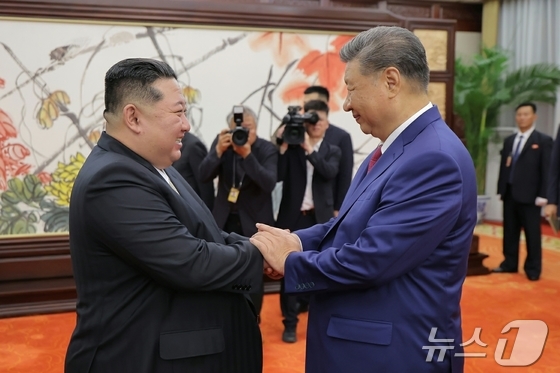
In contrast, North Korea has been drawing closer to China, as evidenced by Kim Jong Un’s surprise attendance at China’s Victory Day celebrations earlier this month. North Korean Foreign Minister Choe Son-hui is scheduled to visit China from September 27 to 30 at the invitation of Foreign Minister Wang Yi, raising the possibility of a visit by President Xi Jinping to North Korea within the year.
President Xi visited South Korea in July 2014, prioritizing it over North Korea after taking office, and only visited North Korea for the first time in June 2019, five years later. Experts note that Xi may feel some ’emotional burden’ over this sequence of events.
A Chinese expert, speaking on condition of anonymity, stated that both China and North Korea place greater importance on party-level exchanges. There’s a possibility that President Xi’s visit to North Korea will coincide with the Workers’ Party founding anniversary on October 10. If he cannot go, he might send Premier Li Qiang instead.”
This situation highlights the deepening ties between North Korea and China, contrasting with South Korea’s current inability to significantly appeal to China on diplomatic matters, given its focus on relations with the U.S.
If President Xi’s visit to North Korea takes place around the Workers’ Party founding anniversary, it could inevitably impact the Asia-Pacific Economic Cooperation (APEC) summit in Gyeongju, scheduled for October 31 to November 1.
Some express concerns that the close ties between North Korea and China—highlighted during the Victory Day celebrations when the leaders of North Korea, China, and Russia stood together at Tiananmen Gate—could shift the focus of APEC from harmony and cooperation to dynamics reminiscent of a new Cold War.