On Tuesday, experts suggested that North Korea, which has demonstrated active foreign policy in the latter half of this year, is likely to maintain a strategic wait-and-see approach until early next year. Kim Jong Un, the General Secretary of the Workers’ Party, exuded confidence during last month’s Supreme People’s Assembly, declaring that time is on their side. The longer they wait, the more advantageous it becomes for them.
As North Korea completes the five-year plan for the economy and defense sectors established during the 8th Party Congress in 2021, it is expected to focus on consolidating its regime until the anticipated 9th Party Congress early next year rather than pursuing rapid change. Analysts predict that the party congress will serve as a platform to unveil a significantly altered foreign strategy.
Strengthening North Korea–Russia Ties and Restoring North Korea–China Relations to Expand the Anti-U.S. Coalition
This year, North Korea’s foreign activities can be characterized by the strengthening of the anti-U.S. coalition. Since the outbreak of the Russia–Ukraine war in 2022, North Korea has deepened its ties with Russia while also demonstrating a clear trend toward restoring its previously strained relationship with China, particularly following the inauguration of Donald Trump’s administration.
In February, Park Myung-ho, North Korea’s Deputy Foreign Minister, met with Wang Yajun, the Chinese Ambassador to North Korea, thereby resuming high-level communications between the diplomatic officials of the two countries for the first time in nearly a year. In March, the North Korean Foreign Ministry underscored the warm welcome extended to Chinese President Xi Jinping during the North Korea–China summit seven years ago, emphasizing that strengthening and developing the North Korea–China friendship to new heights remains the unwavering position of the party and government.
This year marks the 75th anniversary of the Korean War, which China refers to as the War to Resist U.S. Aggression and Aid Korea. Both countries have seized this occasion to revive their blood alliance and reinvigorate dialogue that had previously stagnated.
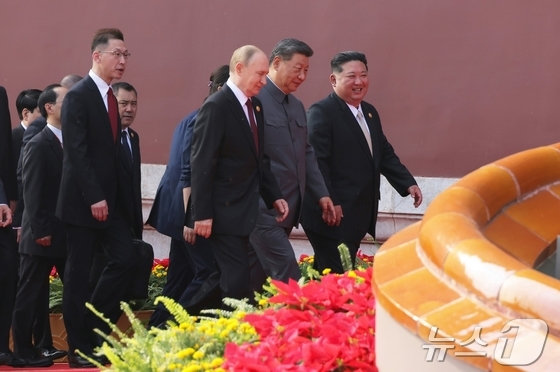
Notably, Kim made his debut on the multilateral diplomatic stage by attending the Victory Day event in Beijing last month, commemorating the 80th anniversary of the victory in the Anti-Japanese War and the global anti-fascist war.
As the international community observed in real time, Kim, alongside President Xi and Russian President Vladimir Putin, walked side by side ahead of other leaders at the Victory Day event, showcasing their collective strength from the Tiananmen Tower. This moment highlighted the special treatment afforded to Kim and underscored the symbolic three-way alliance opposing the U.S.
In addition, Foreign Minister Choe Son-hui traveled to China on his own to discuss international affairs and dispatched a high-ranking official to the United Nations (UN) General Assembly for the first time in seven years, demonstrating North Korea’s proactive diplomatic efforts. This shift appears intended to elevate its standing on the multilateral diplomatic stage in order to secure a favorable position for future negotiations and dialogues.
North Korea continues to strengthen its ties with Russia. In late April, North Korea and Russia officially acknowledged the deployment of North Korean troops to Russia, elevating their relationship to that of blood allies. Since then, North Korea has received various concessions from Russia, further expanding cooperation between the two countries.
Experts predict that the North Korea–Russia relationship will persist for the foreseeable future, even after the conclusion of the Ukraine war, analyzing that North Korea is likely to maintain its strategic alliance with Russia to bolster its leverage against the U.S.
Signals of Conditional Dialogue Amid a Hardline Stance Toward the U.S. Draw Attention to Decisions Made at the 9th Party Congress
Signs of change are emerging in North Korea’s messaging toward the U.S. Recently, Kim opened the door to the possibility of dialogue with former President Trump, albeit raising the bar for negotiations by insisting that it must abandon the denuclearization demands.
At the end of last year, during a plenary meeting of the Workers’ Party, North Korea announced its hardline response strategy toward the U.S., stating that it would respond more forcefully to the South Korea–U.S. alliance and trilateral cooperation with Japan. Although North Korea continues to closely monitor and condemn joint military exercises between the U.S. and South Korea, recent indications suggest a shift in sentiment.
During a speech at the 13th meeting of the 14th Supreme People’s Assembly held on September 20–21, Kim stated that he personally has good memories of former U.S. President Trump, and added that if the U.S. can abandon its unrealistic obsession with denuclearization and face reality, there is no reason for them not to engage with the U.S.
He further emphasized that the world already knows what the U.S. does after disarming and denuclearizing a country, underscoring that it will never give up the nuclear weapons. This highlights the necessity for the U.S. to demonstrate absolute trust by acknowledging North Korea’s nuclear status and abandoning its denuclearization demands.
As for Trump’s related plans, details have not yet been confirmed. All eyes are on whether Trump will make a gesture toward North Korea’ at the upcoming Asia-Pacific Economic Cooperation (APEC) summit at the end of this month.
North Korea is expected to comprehensively assess Trump’s actions during APEC and then determine a new direction for its foreign policy at the 9th Party Congress scheduled for early next year. In doing so, it will likely take into account the changed international landscape following the U.S. presidential election, the realignment of its relations with China and Russia, and the level of domestic unity, in order to outline its diplomatic outlook for the next five years.
North Korea, With its Many Shining Achievements, is Expected to Focus on Internal Consolidation While Preparing for the 9th Party Congress
North Korea is projected to place greater emphasis on strengthening Kim’s regime and domestic cohesion until the end of this year. Major state media outlets have increasingly reported on Kim’s leadership in anticipation of the 80th anniversary of the party’s founding on October 10, highlighting various economic achievements to boost public sentiment.
They will particularly underscore economic successes that have a direct impact on the public. Propaganda emphasizing people-first policies and self-reliance has repeatedly noted that progress has been made despite ongoing sanctions against North Korea.
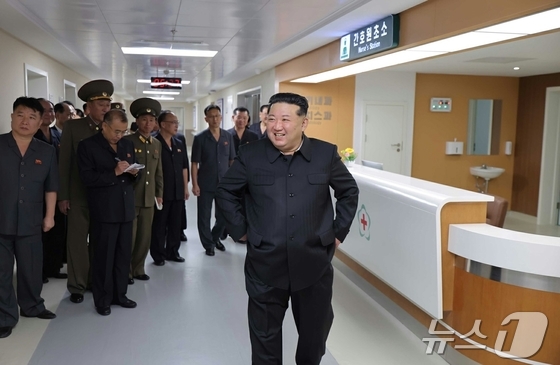
Furthermore, North Korea has declared this year the Year of Health Revolution, pursuing improvements in medical infrastructure, hospital and pharmacy services, and enhancing the quarantine system. Construction of health facilities has continued not only at Pyongyang General Hospital but also in local cities and counties, with some viewing these efforts as preparation for broader foreign engagement.
Since last year, North Korea has been implementing the 20X10 Local Development Policy, which aims to establish industrial factories in 20 cities and counties each year as a key economic initiative. In addition, the construction of grain management facilities, hospitals, and technology dissemination centers has been undertaken to revitalize local economies.
North Korea has publicly declared its intention to complete the five-year national economic development and defense power plans proposed at the 8th Party Congress in early 2021 by the end of this year, and to hold a ‘grand’ 9th Party Congress to chart a new five-year plan. The party’s founding day on Friday is expected to serve as a major catalyst in building momentum ahead of the party congress.