President Donald Trump is extending an olive branch to Kim Jong Un, the General Secretary of North Korea’s Workers’ Party. However, North Korea is showing no signs of reciprocating, instead engaging in provocative actions such as missile launches while strengthening ties with Russia.
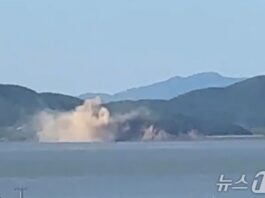
On Wednesday, North Korea announced it had launched a cruise missile over the Yellow Sea the previous day. This missile test occurred just one day before President Trump’s visit to South Korea and immediately following North Korean Foreign Minister Choe Son-hui’s meeting with Russian President Vladimir Putin.
Analysts interpret Choe’s trip to Russia, timed with Trump’s visit, as North Korea’s clear signal of rejecting engagement with the U.S. The subsequent missile launch, a clear military provocation, suggests that North Korea intends to maintain distance from the U.S. while coordinating its moves with Russia.
As Xi Jinping and Trump Gear Up for Crucial Talks, North Korea and Russia Adopting Confrontational Stances Against the U.S.
During China’s 80th Victory Day celebrations on September 3, Kim stood alongside Chinese President Xi Jinping and Russian President Putin atop Tiananmen Tower, showcasing a formidable trilateral alliance. This display underscores a robust anti-U.S. coalition, with Russia opposing the U.S. over Ukraine peace negotiations and China locked in a power struggle with the U.S. over tariffs and security issues.
This strategic alliance is expected to persist through the upcoming Asia-Pacific Economic Cooperation (APEC) summit in Gyeongju. In the lead-up to APEC, Russia, having canceled its summit with the U.S., summoned North Korean officials to Moscow, accusing Washington of escalating global tensions.
For its part, North Korea test-fired a short-range ballistic missile (SRBM) on October 22 with a range comparable to the distance between Pyongyang and Gyeongju (approximately 450 km, about 280 miles). Just one day before Trump’s visit, it launched a cruise missile designed for surprise attacks.
On October 24 and 27, as well as upon his arrival in South Korea, Trump expressed his desire to meet with Kim. He referred to North Korea as a Nuclear Power and hinted at the possibility of easing sanctions. However, Pyongyang’s response has been notably cold.
Some experts suggest that North Korea and Russia’s hardline stance toward the U.S. may be a calculated move to support China’s position in its upcoming summit with Trump. As partners in the trilateral alliance, they seem intent on avoiding any conciliatory gestures toward the U.S. that might undermine Xi’s diplomatic strategy.
Professor Kim Jong of the Graduate School of North Korean Studies stated that given North Korea’s current posture, a Trump-Kim summit during APEC is highly unlikely. Trump’s overtures fall short of Pyongyang’s demands, and North Korea has no incentive to create distractions from Xi’s diplomatic agenda.
Professor Kim Jae-cheon from Sogang University’s Graduate School of International Studies added that North Korea is quietly maneuvering to ensure Xi emerges victorious from the U.S.-China summit. Foreign Minister Choe’s visit to Russia and the recent missile launches are clear demonstrations of authoritarian solidarity with China and Russia.
However, Professor Park Won-gon from Ewha Womans University’s Department of North Korean Studies argues that North Korea’s non-response is more likely a result of its own strategic calculations rather than deference to Xi.
He noted that Kim already laid out his position in his September address, stating that the U.S. must abandon its denuclearization demands before any meeting can be considered. The conditions for U.S.-North Korea engagement simply don’t align at present. Park added that North Korea’s experiences at the 2019 Hanoi summit and the surprise meeting at Panmunjom left them feeling betrayed, likely contributing to their current reluctance to engage.