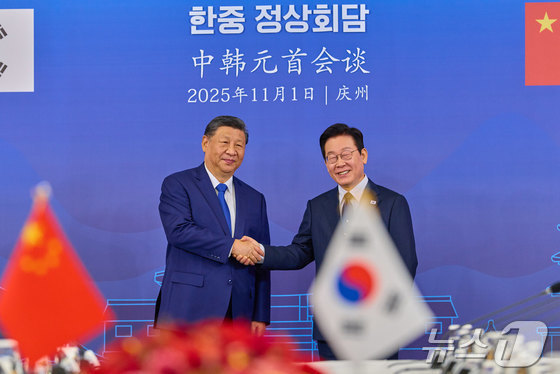
The recent summits between South Korea and the U.S., and South Korea and China, held during the Asia-Pacific Economic Cooperation (APEC) meeting in Gyeongju, were generally viewed as successful. However, critics have raised concerns about both American and Chinese leaders seemingly sidestepping the issue of North Korea’s denuclearization. While major powers have shown increased interest in North Korean affairs, there are growing worries that President Lee Jae Myung’s E·N·D initiative (Exchange, Normalization, Denuclearization) may be losing momentum.
Has North Korea’s Denuclearization Vanished from China’s Agenda? A Noticeable Shift in Attitude
President Lee and President Xi Jinping held a 97-minute summit at the National Gyeongju Museum on November 1. The leaders engaged in wide-ranging discussions on security and economic matters, agreeing to further develop South Korea-China relations.
However, significant differences emerged regarding the critical issue of North Korea’s denuclearization.
According to the South Korean Presidential Office, President Lee outlined the government’s vision for denuclearization and peace, urging China to play a role in resuming dialogue with North Korea. President Xi reportedly responded by pledging continued efforts for peace and stability on the Korean Peninsula. The Presidential Office also noted that Xi reaffirmed China’s commitment to the denuclearization of the Korean Peninsula.
In contrast, the Chinese side barely touched on the Korean Peninsula issue. The state-run Xinhua News Agency reported on Xi’s emphasis on long-term China-South Korea relations, highlighting mutual respect and common development. Xi stressed the importance of respecting each other’s social systems and development paths while managing conflicts through friendly negotiations. Notably absent were any mentions of North Korea or denuclearization.
The phrase considering each other’s core interests is often used by China to avoid taking a clear stance on North Korean issues raised by South Korea, suggesting a deliberate omission of North Korea-related discussions.
Chinese Foreign Minister Wang Yi, while introducing Xi’s diplomatic efforts at APEC and calling South Korea an indispensable partner, also avoided mentioning North Korean issues beyond confirming cooperation on various projects with South Korea.
This approach markedly differs from the 2014 China-South Korea summit joint statement, which explicitly opposed nuclear weapons development on the Korean Peninsula. Overall, China appears to be taking a more protective stance towards North Korea.
This shift likely reflects the strengthening ties between North Korea and China this year. During September’s 80th anniversary of victory in the War of Resistance Against Japanese Aggression, Xi showcased a trilateral alliance with Kim Jong Un and Russian President Vladimir Putin, emphasizing anti-U.S. solidarity. Notably, the outcome of Xi’s summit with Kim omitted any mention of denuclearization, departing from the 2018 and 2019 North Korea-China summit statements. This has led experts to conclude that China has effectively acknowledged North Korea’s nuclear status.
U.S. Pushes for Dialogue with North Korea While Further Sidelining Denuclearization
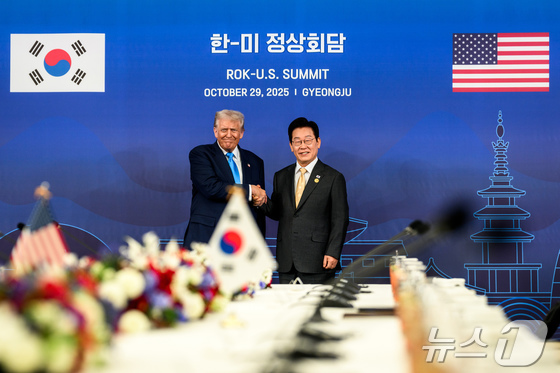
The U.S. stance on North Korea’s nuclear program appears even more overt than China’s. The recent South Korea-U.S. summit on October 29 also failed to address denuclearization in depth.
Post-meeting, the South Korean Presidential Office reported that President Lee explained the commitment to reducing tensions on the Korean Peninsula and advancing denuclearization through a phased approach. President Trump reportedly indicated he would play the necessary role in realizing peace on the Korean Peninsula, based on the 2018 Singapore Agreement.
However, Trump has consistently referred to North Korea as a nuclear power. He has used this term since his re-election campaign and reiterated his desire to meet with Kim ahead of his recent visit.
The South Korean government maintains that Trump’s remarks refer to nuclear-armed North Korea, distinguishing it from recognized nuclear weapon states under the Nuclear Non-Proliferation Treaty (NPT).
Experts believe North Korea values U.S. recognition of its nuclear status more than acknowledgment under the NPT framework. They anticipate North Korea will continue strengthening its nuclear capabilities to secure a favorable position, closely monitoring Trump’s statements. Some critics even suggest that the U.S., once a staunch ally for ‘denuclearization,’ now inadvertently encourages North Korea’s nuclear armament.
This situation continues to enhance North Korea’s strategic position in the Indo-Pacific region while weakening South Korea’s leverage on peninsula issues. The lack of explicit support from major countries like the U.S., China, and Japan for President Lee’s E·N·D initiative further underscores this trend.
While the government’s initiative might gain traction if U.S.-North Korea dialogue progresses, North Korea’s diplomatic isolation of South Korea makes pursuing the Exchange and Normalization aspects of the E·N·D initiative challenging. Pessimistic views currently dominate.
Professor Park Won-gon of Ewha Womans University noted that the absence of clear denuclearization statements in both the South Korea-U.S. and South Korea-China summits indicates that both powers are prioritizing their relations with North Korea. This suggests mounting challenges for the South Korean government’s North Korea strategy, which explicitly aims for denuclearization.